Digestive Aids & Probiotics for Dogs – A Practical Guide for Owners
Digestive health is not just about what you feed your dog.
It’s about what their body can actually do with that food.
A dog might be eating a well-balanced diet, but if their digestion is unstable, nutrients aren’t absorbed properly, energy levels fluctuate, and small issues can quietly build into bigger problems over time.
That’s where digestive aids and probiotics come in.
They can support gut balance and help stabilize digestion — but they’re not magic fixes. They’re tools. And like any tool, they only work properly when used in the right situation.
What Are Digestive Aids?
Digestive aids are products designed to support how the digestive system functions.
This can include probiotics, which are beneficial bacteria that help maintain a healthy gut environment. There are also prebiotics, which act as food for those beneficial bacteria, helping them grow and function properly.
Some products focus on digestive enzymes, which help break down food so nutrients can be absorbed more efficiently. Others provide fiber to support stool consistency or combine several ingredients into general gut-support formulas.
You might also come across blends that include soothing plant-based ingredients designed to calm mild digestive irritation.
The important thing to understand is this:
Digestive aids support normal function. They don’t replace proper nutrition, and they don’t solve underlying medical problems.
Good digestion starts with feeding your dog correctly in the first place — matching food to their age, activity level, and individual needs.
Signs Your Dog’s Digestion May Be Off
Dogs can’t explain how they feel, so digestion problems usually show up through small, everyday signals.
Sometimes it’s obvious, like diarrhea or vomiting. Other times, it’s more subtle.
You might notice stools that are consistently soft, even if they’re not full diarrhea. Gas can become more frequent, or your dog’s appetite might fluctuate for no clear reason. Some dogs start to lose or gain weight unexpectedly, while others develop a dull coat.
Even something as simple as irregular bathroom patterns can be a sign that digestion isn’t as stable as it should be.
This is where your observation matters.
Dog Gut Health Symptoms (The Cause, Best Probiotics and Diet)
Stool quality is one of the most important indicators of digestive health. It tells you far more than most people realize — often before bigger issues appear.
Before looking at supplements, it’s worth stepping back.
Most digestive issues don’t start because a dog “needs probiotics.” They start because something in the feeding routine isn’t quite right.
Changing food too quickly is a common cause. Switching brands every few weeks can also create instability. Overfeeding, inconsistent mealtimes, or feeding a diet that doesn’t match the dog’s life stage or activity level can all put stress on digestion.
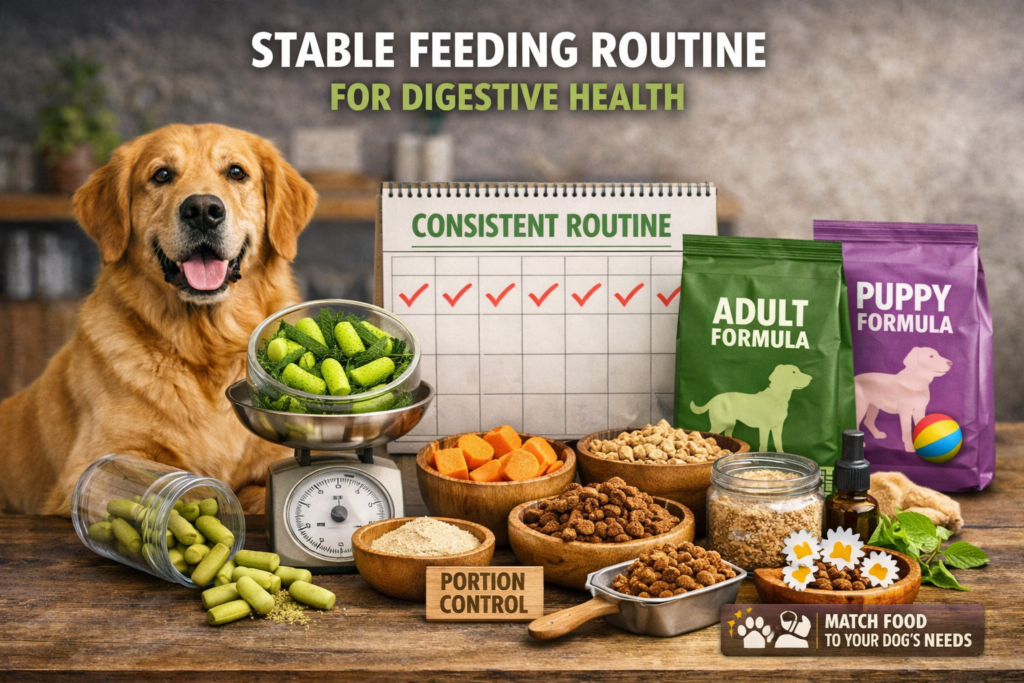
A stable routine makes a bigger difference than most supplements ever will.
When feeding is consistent, portions are appropriate, and the food matches the dog’s needs, digestion usually becomes more predictable as well.
In other words, the best digestive support is often simply feeding correctly.
Products That Can Support Digestion
When the basics are in place, digestive aids can play a useful role.
Probiotics are one of the most commonly used options. They help support the balance of bacteria in the gut, which can be useful after antibiotics, during mild digestive upset, or when a dog is under stress, such as during travel.
Prebiotics work alongside this by feeding the beneficial bacteria already present in the gut, helping them stay active and effective.
Digestive enzymes can be helpful for dogs that struggle to break down food properly. They support nutrient absorption and can sometimes reduce issues like bloating or inconsistent stool.
Fibre supplements are often used to stabilise stool, especially when it tends to swing between too soft and too firm.
There are also general gastrointestinal support formulas that combine several of these elements, sometimes with added ingredients to soothe mild irritation.
But it’s important to keep perspective.
These products should support a good diet — not compensate for a poor one.
There’s a clear line between mild digestive imbalance and something more serious.
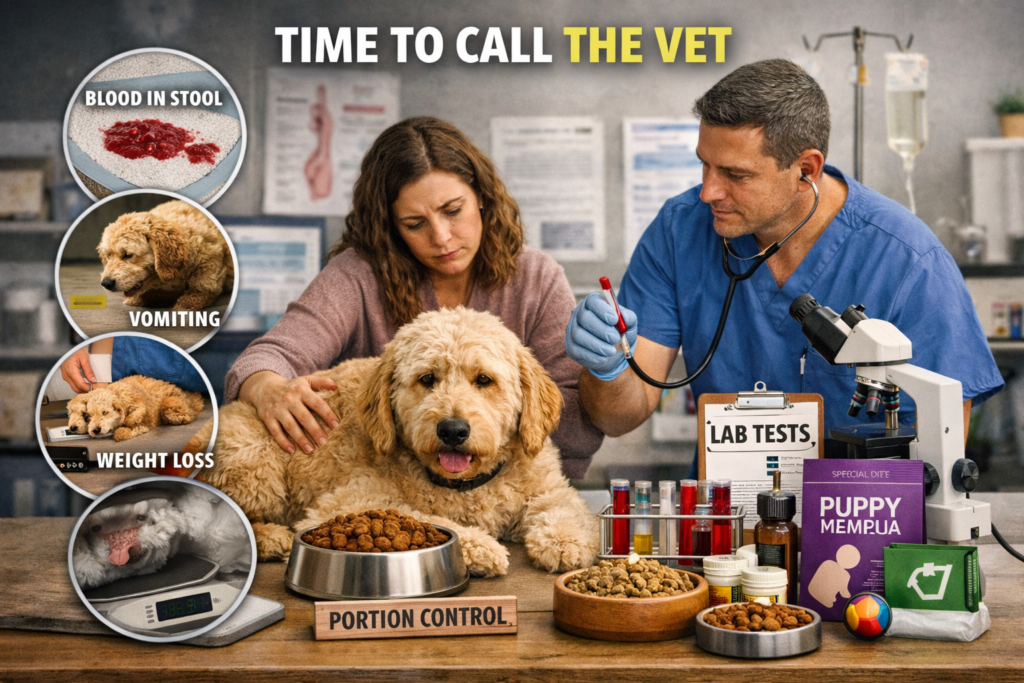
If diarrhea lasts more than a couple of days, or if you notice blood in the stool, ongoing vomiting, or rapid weight changes, it’s time to involve a veterinarian.
Lethargy, visible discomfort, or repeated digestive problems are also warning signs.
Puppies, in particular, should never be left with digestive issues for long. Their systems are still developing, and problems can escalate quickly.
Supplements are not a substitute for medical care. If something seems off beyond a short, mild episode, it needs proper attention.
What Veterinary Treatment May Involve
If a digestive issue becomes persistent, a vet will usually look deeper.
This might involve testing stool samples, run blood work, or recommending a specific diet designed for gastrointestinal support. In some cases, medication or treatment for parasites may be needed.
The goal isn’t just to stop the symptoms — it’s to understand the cause.
Chronic digestive problems are rarely random. They require proper diagnosis, not guesswork or trial-and-error feeding.
Home Support for Mild Cases
For short-term, mild digestive upset, simple approaches can sometimes help.
A temporary bland diet, recommended by a vet, can give the digestive system time to settle. Plain pumpkin is sometimes used to support stool consistency, and keeping hydration levels stable is always important.
Short-term use of probiotics can also support recovery in these situations.
But these are temporary measures.
If symptoms continue, they need to be taken seriously.
Dogs More at Risk of Digestive Issues
Some dogs are simply more prone to digestive instability than others.
Frequent diet changes are one of the biggest triggers. Free feeding can also contribute, as it removes structure from digestion.
High-fat treats, stress, travel, and antibiotic use can all disrupt gut balance.
Large and giant breed dogs going through rapid growth can also be more sensitive, especially if their diet isn’t carefully managed.
Working dogs, due to physical and mental stress, may experience digestive fluctuations as well.
In most cases, these risks can be reduced with structured feeding and careful observation.
Breed and Individual Differences
Not all dogs’ process food in the same way.
Some breeds are more prone to sensitive digestion, food intolerances, or conditions like inflammatory bowel disease. Others may have a higher risk of issues like bloating or poor nutrient absorption.
This is why a one-size-fits-all approach to feeding rarely works well long term.
Understanding your dog as an individual — including their breed tendencies — helps you make better decisions about both nutrition and digestive support.
Digestion isn’t just physical. It’s also linked to a dog’s mental state.
Stress can affect the gut in very real ways.
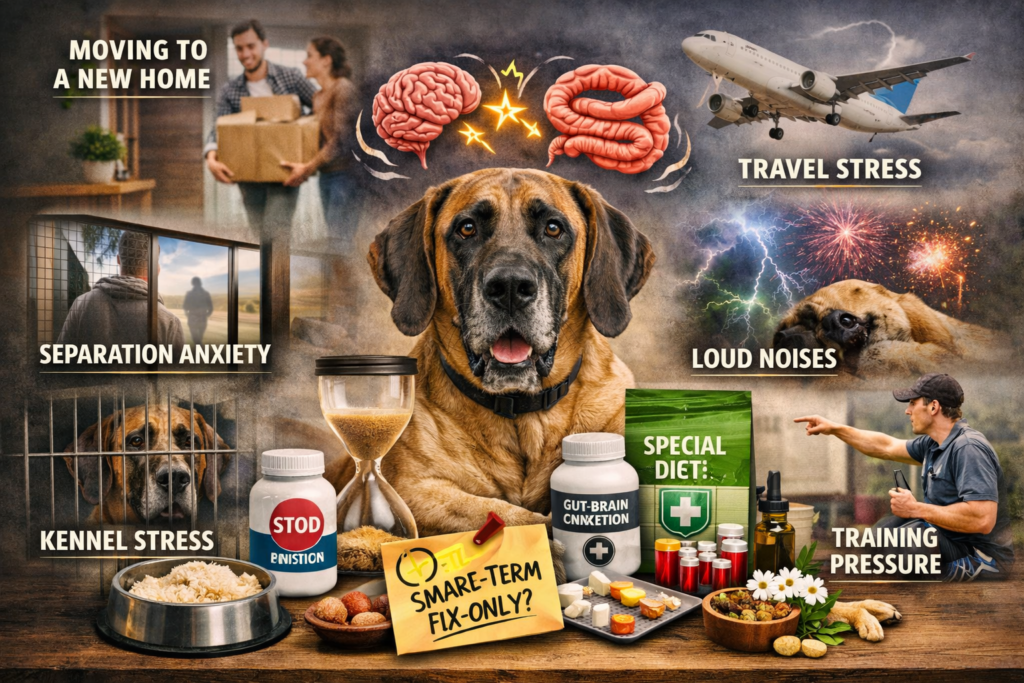
Changes in environment, separation anxiety, training pressure, or even travel can trigger digestive upset. Some dogs respond with loose stool, others with reduced appetite.
This is often referred to as the gut-brain connection, and it’s something many owners overlook.
If a dog’s environment is unstable, their digestion often is too.
When Surgery Becomes Necessary
In more serious cases, digestive issues may be caused by physical problems such as blockages or severe gastrointestinal disease.
This can require surgical intervention, especially if a foreign object has been swallowed or there is an obstruction.
These situations are emergencies.
They are not something that can be managed with supplements or home care, and they require immediate veterinary attention.
Gastric Dilatation-Volvulus (GDV) & Gastropexy
Monitoring Digestive Health
One of the most effective things you can do as an owner is simply pay attention.
Digestive health shows up in daily patterns — stool consistency, appetite, energy levels, and even coat condition.
When these remain stable, it’s a good sign that nutrition and digestion are working together properly.
When they start to shift, it’s often an early signal that something needs adjusting.
Digestive aids are most effective when they’re used alongside this kind of awareness.
Being Prepared Matters
It’s always worth having basic information ready in case something goes wrong.
Knowing how to contact your regular vet, where the nearest emergency clinic is, and what to do in urgent situations can make a real difference.
Digestive issues can escalate quickly in some cases, and being prepared helps you act without hesitation.
Final Thoughts – Support, Don’t Replace
Digestive aids and probiotics have their place.
They can support gut health, help during mild disruptions, and play a role in maintaining stability. But they are not a replacement for proper feeding, and they are not a solution for serious medical issues.
Healthy digestion starts with intelligent nutrition.
Feed appropriately for your dog’s age and activity level. Keep routines stable. Pay attention to small changes.
Support digestion when needed — but more importantly, protect it through good decisions every day.
Dog Nutrition – Feeding by Life Stage, Activity & Individual Needs
Dog nutrition is not static.
If you’ve ever watched a puppy sprint full speed across a field and then crash into a nap five minutes later, you already understand this instinctively. A puppy does not eat like an adult. An adult does not eat like a senior. And a relaxed companion dog definitely does not eat like a working dog.
Yet a lot of people feed the same food, in the same way, for years — assuming it “covers everything.”
Biology doesn’t work like that.
Dogs grow, develop, slow down, and change over time. Their metabolism shifts. Their muscles build and later decline. Their energy needs rise and fall depending on lifestyle. Proper nutrition isn’t about picking one “perfect” food — it’s about adjusting as your dog changes.
This guide is built to help you do exactly that: feed the dog in front of you, not the one printed on the bag.
The Foundation of Dog Nutrition
Nutrition isn’t just about filling a bowl and keeping your dog from being hungry. It affects almost every system in their body — from how they grow to how they age.
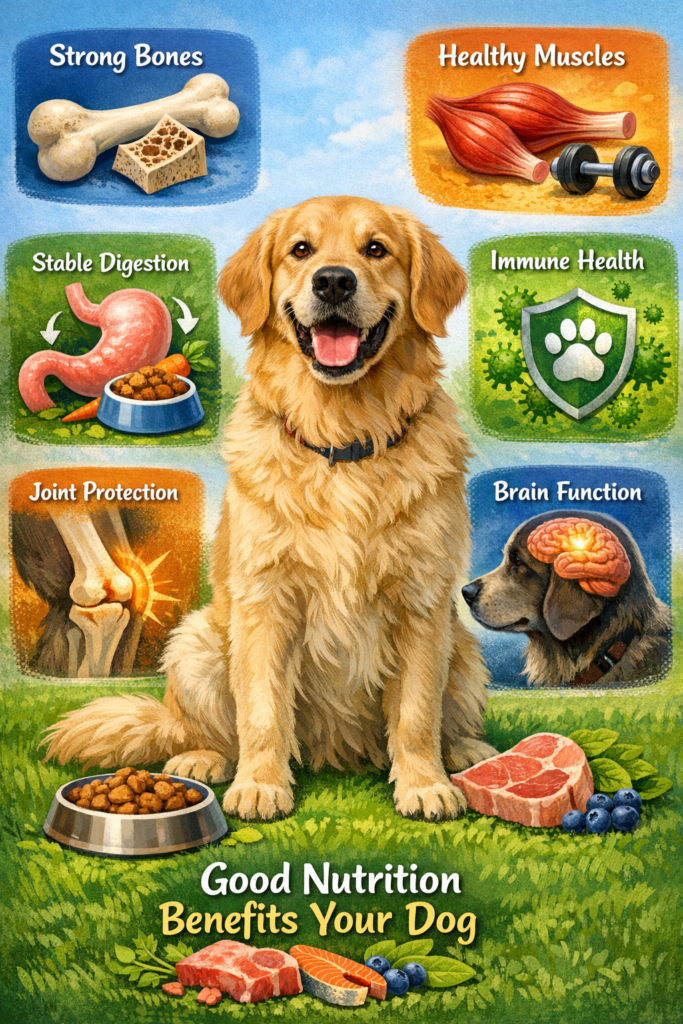
Good nutrition supports things like strong bones, stable digestion, healthy muscles, and consistent energy. It plays a role in immune health, joint protection, and even brain function, especially as dogs get older.
But here’s the part people often miss:
Nutrition is not just about calories. It’s about balance.
Too many calories without proper balance leads to weight gain. Too much calcium in a growing dog can affect how their skeleton develops. Too little protein in an older dog can speed up muscle loss.
So feeding well isn’t just about keeping a dog “full.” It’s about supporting how their body works — now and long-term.
Nutrition Changes with Life Stage
One of the biggest factors in how you should feed a dog is their age. What works for one stage of life can actually cause problems in another.
Puppies are developing everything at once — bones, muscles, organs, and their immune system. Because of that, their nutrition needs to be carefully controlled.
A common mistake is thinking faster growth is better. It’s not.
Especially in larger breeds, growing too quickly can put stress on developing joints and bones. That’s why balance matters more than speed.
Puppies need structured meals throughout the day, controlled portions, and the right balance of nutrients — not just “more food.”
Adult Nutrition – Finding Balance
Once a dog reaches adulthood, the goal shifts. Now it’s about maintaining a healthy body and matching food intake to actual activity.
This is where a lot of dogs start gaining weight — slowly, almost invisibly.
An hour-long hike and a short backyard walk are not the same thing, but many dogs are fed as if they are. Over time, that mismatch adds up.
Adult dogs need consistency. Not excess.
Senior Nutrition – Supporting Longevity
As dogs age, things change again. Their metabolism slows down, but their need for quality nutrition doesn’t disappear.
In fact, older dogs often need more support in specific areas — like maintaining muscle, protecting joints, and keeping digestion stable.
Weight control becomes more important, not less. And small changes in appetite or digestion should never be ignored.
Good nutrition at this stage is about preserving quality of life.
Nutrition Also Changes with Activity Level
Age is only part of the picture. How active a dog is plays just as big a role in how they should be fed.
A companion dog that mostly relaxes at home has very different needs than a dog that’s constantly training, working, or exercising.
Less active dogs are at higher risk of gradual weight gain. It happens slowly, which makes it easy to miss until it starts affecting movement and health.
More active dogs burn more energy, but that doesn’t mean unlimited feeding. They still need structure — just adjusted to match what they actually do.
Working dogs are in a category of their own. Their feeding needs to be intentional and performance-based, not just “more food in the bowl.”
Why “One Brand for Life” Can Be a Problem
Sticking to one food for years might feel simple — even responsible. But it can ignore some important realities.
Dogs change over time. Their needs shift with age, activity, and health. Even the food itself can change as formulas are updated.
So while consistency is helpful, blind loyalty to a single product can work against your dog if their needs are no longer being met.
A better approach is simple: stay loyal to your dog’s needs, not just the label on the bag.
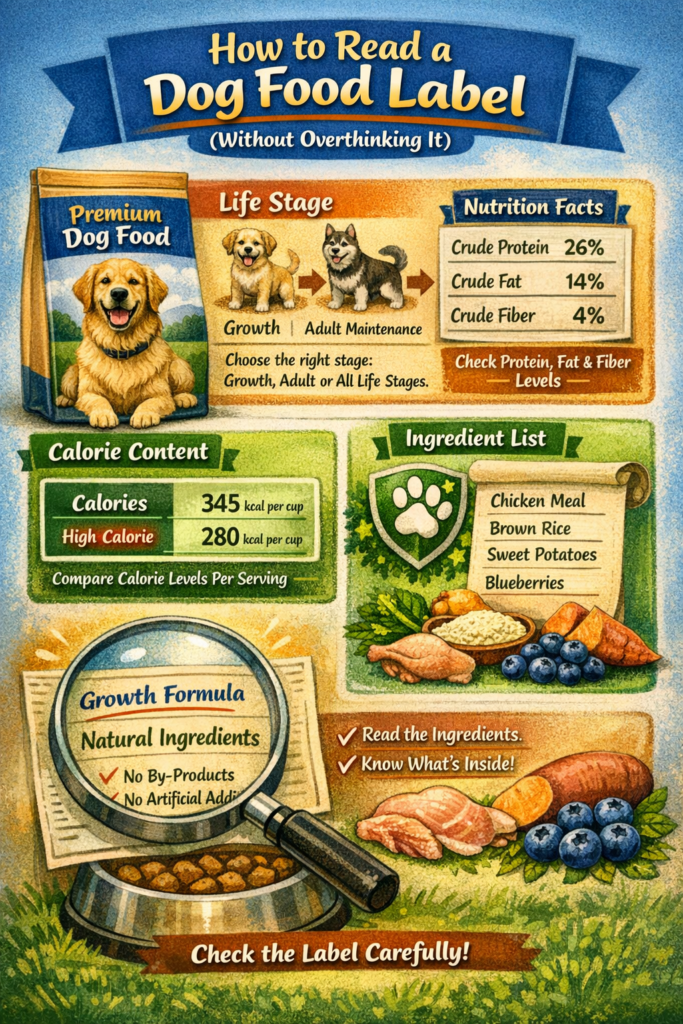
How to Read a Dog Food Label (Without Overthinking It)
Dog food labels can look complicated, but once you know what to look for, they become much easier to understand.
Start with the life stage. Is the food designed for growth, maintenance, or all life stages? This matters more than most people realize. A food designed for growth may contain levels that are unnecessary — or even excessive — for adult or senior dogs.
Next, look at the basic nutritional breakdown. Protein, fat, fiber — these numbers matter, but they don’t tell the whole story on their own. Higher numbers don’t automatically mean better food.
Calorie density is one of the most overlooked details. Two foods can look similar but have very different calorie levels per serving. That difference can lead to gradual weight gain if you’re not paying attention.
Finally, take a realistic look at the ingredients. Ignore the marketing buzzwords and focus on whether the ingredients make sense and are clearly identified.
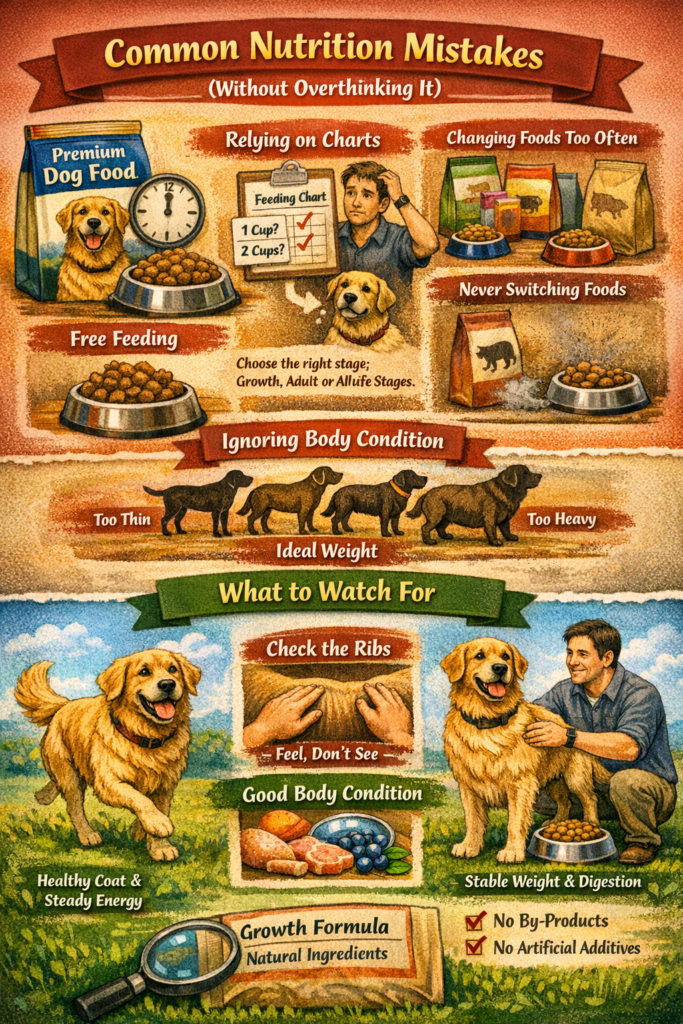
Common Nutrition Mistakes
Even well-meaning dog owners make mistakes when it comes to feeding.
One of the most common is free feeding — leaving food out all day. It removes structure and makes it much harder to control intake.
Another is relying too heavily on feeding charts. These are starting points, not exact instructions. Every dog is different.
Some owners switch foods too often, while others never adjust at all. Both extremes can cause issues.
And one of the biggest mistakes? Judging food amounts based on habit instead of body condition.
Your dog’s body will always give you better feedback than a chart.
What to Watch For
You don’t need to be a vet to tell if your dog’s nutrition is working.
A healthy dog will have steady energy, a consistent appetite, and normal digestion. Their coat should look healthy, and their weight should stay stable over time.
You should be able to feel their ribs without them being visibly prominent. Their body should look defined, not rounded.
These small observations matter more than most people think.
The Role of Digestive Awareness (D.A.W.G.)
Nutrition and digestion go hand in hand.
Even the highest-quality food won’t help if your dog isn’t digesting it properly. Things like soft stool, gas, or inconsistent appetite are not just minor issues — they’re signals.
This is where the D.A.W.G. system (Digestive Awareness & Wellness Guide) becomes important. It helps you pay attention to what your dog’s body is telling you, not just what you’re feeding them.
Because feeding well only works when digestion is stable.
Sometimes, adjusting food on your own isn’t enough — and that’s okay.
If a dog has ongoing digestive issues, sudden weight changes, or signs of food intolerance, it’s time to involve a professional.
Getting guidance early can prevent small problems from becoming bigger ones.
Feed the Dog in Front of You
Your dog is an individual.
They are not a feeding chart. They are not a brand. And they are definitely not identical to any other dog — even within the same breed.
Good nutrition comes down to observation and adjustment. Watching how your dog responds. Making changes when needed. Staying aware of how age, activity, and health affect their needs.
Feeding well isn’t about trends or perfect formulas.
It’s about paying attention — and responding to what your dog is telling you.
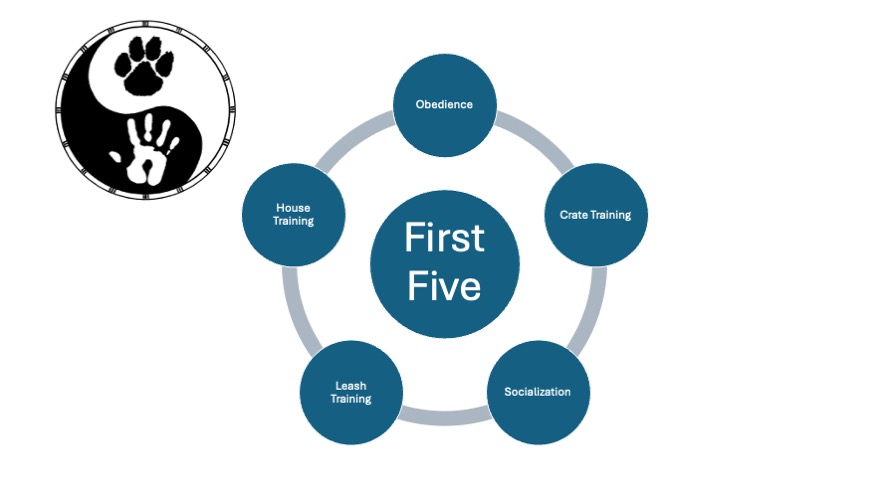
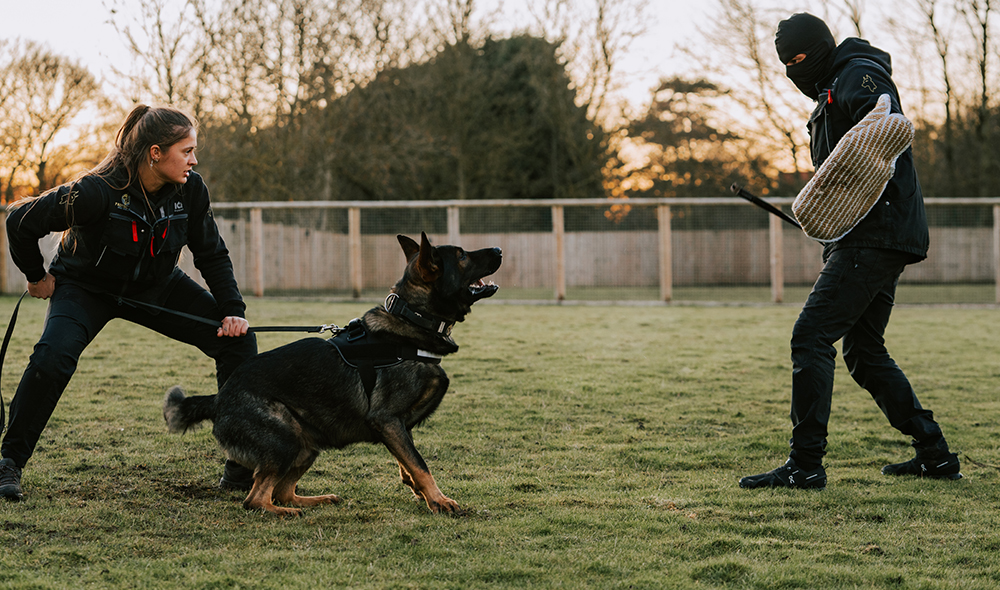
Some dogs are born to move. Others live to protect, to guide, or to solve problems—and they feel restless without a role. The Skill Tracks were built to honor that instinct. Each one offers a focused path of continuing education after the First Five and Social Code work are in place.
Protection Training exists because some dogs need more than manners—they need a mission. This isn’t about competitive trophies or social media stunts. It’s about nurturing your dog’s true nature, giving their instincts a safe outlet, and strengthening the working bond between human and giant.
When this Skill Track is done right, it develops a dog’s natural potential while refining the human’s leadership, timing, and emotional connection. It helps the owner understand what listening actually looks like—and shows the dog what being understood feels like.
And yes, Social Code matters here too. Skill Tracks don’t override temperament—they enhance it. Compatibility with your dog’s Social Code Setting determines whether this Track will be a joy… or a job.
What This Training Develops
Every Skill Track leaves a lasting mark on both dog and human. Here’s what Protection Training builds:
🦴 Physical:
Stamina, coordination, and full-body confidence.
Dogs learn to move with controlled power—even under pressure.
🧠 Mental:
Pattern recognition, threat assessment, and advanced cue interpretation.
Encourages judgment alongside response.
❤️ Emotional:
Confidence and composure in high-stimulation scenarios.
Strengthens the dog’s trust in their handler as a leader and partner.
Social Code Compatibility
Protection training does not create instinct — it shapes it.
Most dogs, especially giant breeds, already possess a deep, natural drive to protect their pack. Once a dog has bonded with a household, they do not see themselves as a pet standing apart — they see themselves as part of a living system. In moments of uncertainty, tension, or perceived threat, they look to their human for guidance on how to respond.
This is where the Social Code becomes essential.
Protection work only succeeds when the human understands how their dog reads the world — and how easily a single cue, tone, or hesitation can shift a dog from calm observation to decisive action. Mastery of the Social Code ensures the dog does not misread everyday situations as threats, or worse, act decisively when restraint was required.
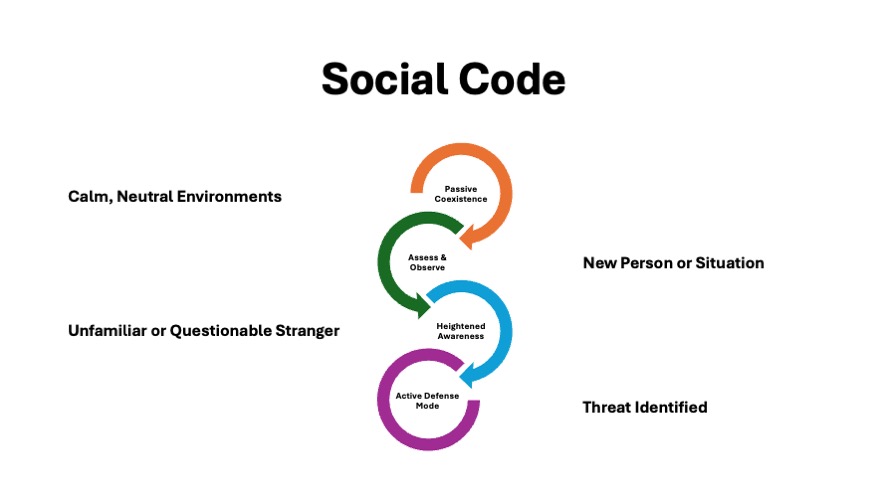
Setting 1: Passive Coexistence
(Calm, Neutral Environments)
In Setting 1, the goal is neutrality, not vigilance.
Dogs in this setting are learning that not every environment requires engagement. For protection-trained dogs, this setting prevents false positives — mistaking normal life for a reason to act.
Dogs should remain calm, grounded, and observant without scanning for threats.
Training emphasizes stillness, patience, and disengagement.
Owners must be consistent with boundaries, so the dog does not invent “jobs” where none exist.
Protection training fails here when owners unintentionally reward alertness in neutral spaces. A dog that never learns to relax cannot distinguish danger from daily life.
Setting 2: Assess & Observe
(New Person or Situation)
This is the most critical setting for protection work.
Here, the dog is allowed awareness — but not action.
The dog notices change, novelty, or unfamiliar presence.
The human provides clear signals: observe, not engage.
Calm posture and steady communication teach the dog to wait for instruction.
If owners are unclear or emotionally reactive in this setting, dogs may escalate prematurely. Protection training reinforces that alert does not mean act — and that leadership comes from clarity, not tension.
Setting 3: Heightened Awareness
(Unfamiliar or Questionable Stranger)
In Setting 3, protection instinct begins to surface — but control must remain absolute.
The dog becomes watchful, grounded, and focused.
The goal is controlled readiness, not aggression.
Training focuses on holding position, maintaining eye contact with the handler, and awaiting direction.
This is where many misunderstandings happen. If an owner signals uncertainty, fear, or conflicting intent, the dog may attempt to “solve” the situation on their own. Protection training exists precisely to prevent that — ensuring the dog waits instead of assumes.
Setting 4: Active Defense Mode
(Threat Identified)
This setting is rare — and intentional.
The dog responds only when a real threat is present.
Action is guided, purposeful, and proportional.
Immediate release and de-escalation are as important as engagement.
A dog that reaches this level without proper Social Code mastery is a liability — not a protector. True protection training ensures the dog understands not just how to act, but when to stop.
Why This Matters
Dogs do not understand laws, social norms, or human nuance. They understand signals.
If an owner does not know what they are communicating — whether asking a dog to stay calm, remain alert, or disengage — the dog will still act. It will simply act based on instinct rather than guidance.
Protection training, when built on the Social Code, transforms instinct into discipline. It keeps people safe — including the dog.
Social Code does not limit a dog’s ability. It defines the language that keeps power under control.
And in protection work, control is everything.
⚠️ Legal & Responsibility Sidebar: Protection Training and the Law
Protection training exists at the intersection of instinct and human law — and dogs do not understand the difference.
A giant breed dog may believe it is acting correctly by protecting its pack when it senses fear, tension, or threat. But human legal systems judge outcomes, not intentions. If a dog reacts without clear guidance or exceeds what a situation legally allows, the consequences fall entirely on the owner — regardless of the dog’s motivation.
This is why control is not optional. Protection training does not give a dog permission to act independently. It teaches the human how to communicate clearly, consistently, and responsibly so the dog never has to guess what is required.
Without that control, even a well-meaning guardian response can be interpreted as dangerous or negligent — especially when the dog involved is large, powerful, and capable of causing serious harm.
Owner Legal & Safety Considerations
You are always legally responsible for your dog’s actions, even if the dog believed it was protecting you or your family.
Size matters in the eyes of the law. Giant breeds are often judged more harshly due to their strength and potential for injury.
Intent does not override outcome. A protective response may still be classified as aggression or negligence.
Poor communication creates liability. Mixed signals, emotional reactions, or fear-based cues can escalate situations unnecessarily.
Protection training is not a substitute for control. A dog must be able to disengage immediately on command.
Local laws vary. Some regions impose stricter penalties, insurance requirements, or restrictions on protection-trained dogs.
Public perception matters. How a situation looks to bystanders or authorities can influence legal outcomes.
Failure to intervene is a failure of leadership. Owners must actively manage environments, situations, and exposure.
The Core Rule to Remember
A dog should never be forced to decide what “protection” means on its own.
Protection training is not about creating a weapon — it is about preventing mistakes, protecting the dog as much as the human, and ensuring that instinct is always guided by clarity and restraint.
When done responsibly, protection training reduces risk. When done poorly, it magnifies it.
Giant Breeds That Fit This Track
✅ Excellent Fit
These breeds are naturally inclined toward protective roles:
Always train the dog in front of you. Temperament matters more than breed labels.
Training Goals & Milestones
Protection begins long before any formal training ever starts.
Once a dog and human have truly bonded inside a household, most dogs do not need to be taught to protect. They already understand who belongs to their pack. They already feel responsibility for shared space, shared routines, and shared safety. For many giant breeds especially, this instinct is quiet, watchful, and deeply rooted. Given the right circumstances, they will place themselves between danger and those they love — sometimes at great personal risk.
That instinct is not the problem. Unclear guidance is.
Protection training exists not to create aggression, but to shape instinct into discernment. It gives the dog boundaries, context, and permission structures. It teaches the human how to lead without panic, how to read escalation without overreaction, and how to act as a steady anchor when the dog’s protective drive is activated. This is not about domination or intimidation — it is about partnership, clarity, and trust shared by every member of the dog’s pack.
When done correctly, protection training strengthens the bond rather than testing it.
Beginner Milestones: Awareness Without Escalation
At the beginner level, the goal is not confrontation — it is control.
Dogs learn how to recognize unusual stimulus and respond in measured ways. Alert barking becomes intentional rather than reactive. Commands like “watch” and “enough” establish a clear on/off switch, reinforcing that the handler — not the environment — determines the next move. Early guard routines focus on confidence, posture, and presence rather than physical engagement.
This stage is about teaching the dog that not every concern requires action — but every concern should be communicated.
Intermediate Milestones: Engagement With Guidance
As training progresses, the dog is asked to maintain composure under distraction. Movement, noise, unfamiliar people, or environmental pressure are introduced gradually. The emphasis shifts toward handler-focused redirection — the dog learns to look to the human for instruction even when instincts are activated.
Controlled physical exercises may appear here, such as barrier work or structured push-back drills. These are not about force. They are about teaching the dog how to apply presence without losing judgment. The dog learns that restraint is strength, and that disengagement is not failure — it is obedience.
Advanced & Specialist Milestones: Precision Under Pressure
At advanced levels, protection work becomes less about intensity and more about precision
Dogs learn to differentiate between threat levels, responding appropriately to escalation rather than defaulting to maximum response. Handler protection becomes a coordinated effort — positioning, timing, and communication working as one system. Under pressure, the dog remains responsive, grounded, and emotionally regulated.
This stage demands maturity, social stability, and a rock-solid foundation in the First Five and Social Code work. Not every dog — and not every household — needs or should pursue this level.
And that’s not a limitation. It’s wisdom.
A Final Word on Progression
Protection training is never paced by human ambition or timelines. It unfolds according to the dog’s emotional readiness, social stability, and trust in their handler. Rushing this work does not make a stronger protector — it creates confusion and risk.
When done responsibly, protection training doesn’t turn a dog into a weapon. It turns instinct into judgment. Power into restraint. And loyalty into a calm, reliable presence when it matters most.
That is the real goal.
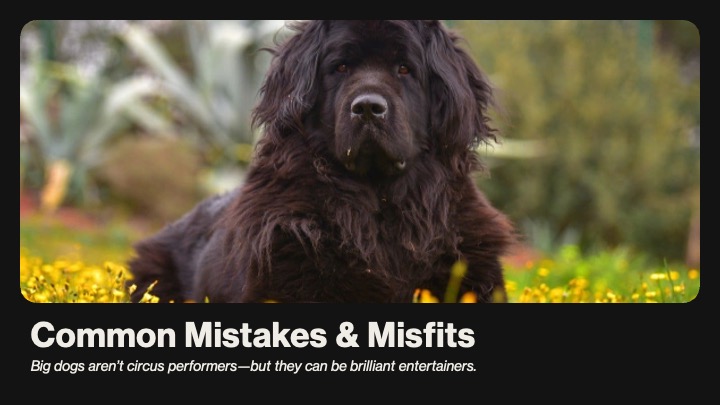
Common Mistakes & Misfits
Protection training attracts attention — and with it, misunderstanding.
This Skill Track is often chosen for the wrong reasons, by well-meaning people who underestimate both the responsibility and the relationship it demands. Before moving forward, it’s worth naming the most common missteps — not to discourage, but to prevent harm.
❌ Mistake #1: Choosing This Track Out of Fear
Some owners arrive here because they are afraid.
They hope the dog will become a shield — a living alarm system that handles danger, so they don’t have to. But protection training does not outsource courage. It builds it, together.
This Track:
Teaches control, not dominance
Builds confidence in the human as much as the dog
Requires calm leadership, emotional regulation, and presence
A fearful owner asking a dog to “handle it” without guidance creates confusion — and confusion is dangerous. Protection work is not a party trick or a shortcut to safety. It is a partnership that demands growth on both ends of the leash.
❌ Mistake #2: Assuming Anxiety or Aggression Equals Protection Ability
An anxious or reactive dog is not a good candidate by default.
Fear-driven behavior looks intense, but it lacks judgment. True protection requires:
Emotional stability
Clear thinking under pressure
The ability to wait as well as act
A dog that reacts to everything cannot distinguish real threats from imagined ones. Without structure, that intensity turns inward — into stress, unpredictability, and eventual shutdown or escalation.
❌ Mistake #3: Skipping the Foundations
No dog should enter this Skill Track without a solid grounding in:
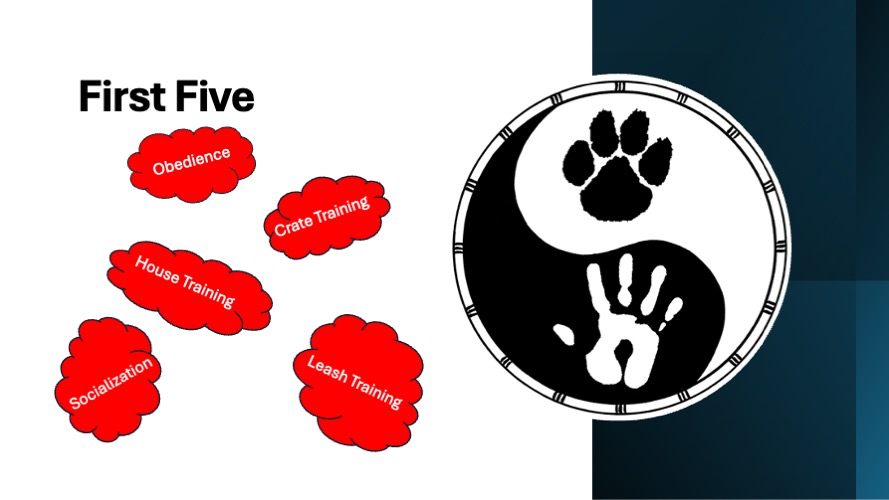
The First Five (basic obedience, impulse control, handler trust)
The Social Code (understanding when to observe, when to disengage, and when action is appropriate)
These are not optional prerequisites — they are safety systems.
Protection training magnifies whatever foundation already exists. If the base is shaky, the consequences are real. This Track should always point backward as well as forward — reinforcing earlier work, not replacing it.
❌ Mistake #4: Pushing Before the Dog Is Ready
Emotional readiness matters as much as physical maturity.
Rushing protection work can create:
Lasting fear responses
Misplaced suspicion
Insecurity masked as aggression
We once took in a young Great Dane who illustrated this painfully well.
Her owner had acquired her as a puppy “for protection.” The woman was deeply afraid of men and assumed the dog’s instincts would simply activate on their own. No guidance. No structure. No training — just fear.
What she taught that puppy was not protection, but panic.
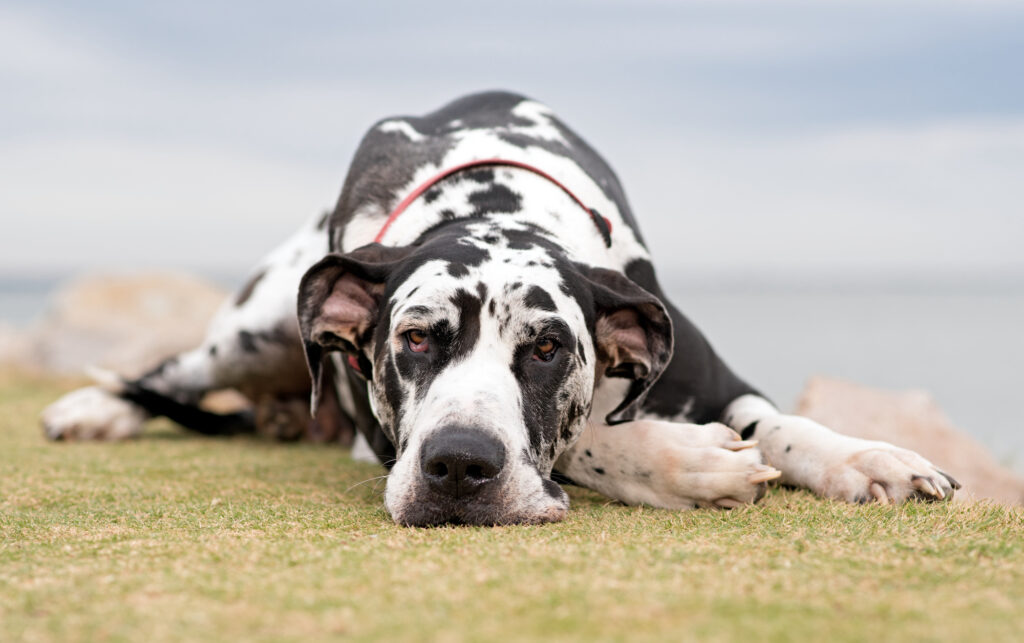
By nine months old female Dane, the Dane was over 100 pounds and terrified of men. When she came to us, she was scared out of her mind — especially of me. If I was watching tv and laughed too loud she urinated the floor. Undoing the damage took months of careful work, trust rebuilding, and re-teaching that the world a safe again.
That is not protection training. That is neglect with consequences.
When This Track Is a Misfit
Protection Training may not be right if:
The owner is unwilling to develop calm leadership
The dog lacks emotional stability or foundational training
Fear — human or canine — is driving the decision
The goal is intimidation rather than safety and control
This Track is powerful. And power without understanding always cuts the wrong way.
Protection training, done correctly, creates a dog who is steady, discerning, and deeply bonded to their human — not a weapon, not a liability, but a guardian guided by trust.
If there is doubt, the wisest move is not to push forward — It is to strengthen the foundation beneath you first.
And that, too, is leadership.
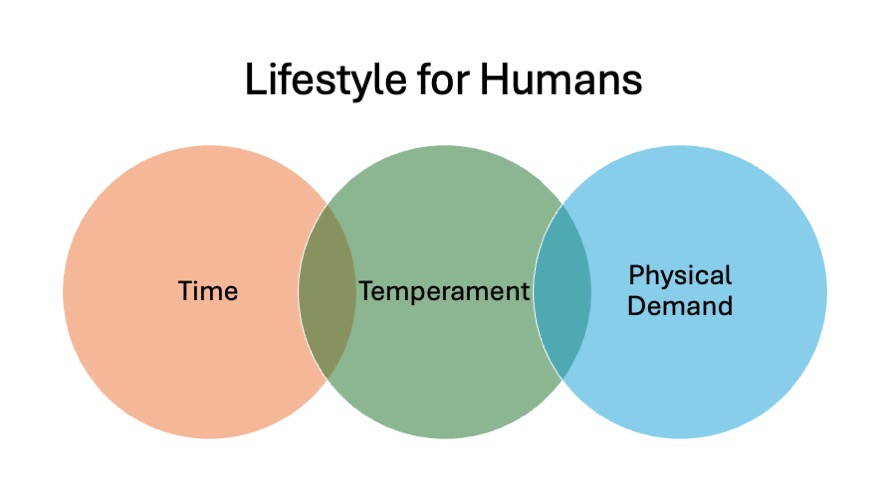
Lifestyle Fit for the Human
Protection training is not something you hand off and pick up later like a finished appliance. It is a living system of communication between you and your dog — and you are part of the equipment.
This Track asks more of the human than almost any other. Not because you must be physically dominant or athletic, but because you must be present, consistent, and understandable to your dog. Protection work only functions safely when the handler and dog share a clear, practiced language of cues, boundaries, and expectations.
⏱️ Time Commitment
Expect 2–4 structured sessions per week, plus daily reinforcement in real-life situations. Calm exposure work — walks, visitors, controlled environments — matters just as much as formal drills. This isn’t about drilling aggression; it’s about practicing restraint.
🧰 Space & Tools Required
You’ll need basic control tools: leashes, long lines, barriers, and access to a controlled training environment. Professional equipment (such as bite sleeves or decoys) should only be introduced under expert guidance. Most of the work, however, happens without dramatic props — in posture, voice, and timing.
💪 Physical Demand (and the Reality of Limitations)
Yes, protection training can be physically demanding — giant breeds are powerful animals. But physical strength is not the deciding factor.
What matters more is participation.
There are owners who use wheelchairs, walkers, or live with chronic illness who successfully work this Track — because they stay involved. They don’t send the dog away to be “made protective” and hope for the best. They work alongside a trainer, learn the cues, practice the handoffs, and reinforce the rules in daily life.
A dog cannot protect someone safely if they don’t understand that person’s signals.
You don’t have to run, wrestle, or overpower your dog — but you do have to communicate with them clearly and consistently. Protection training without owner involvement creates confusion at best… and danger at worst.
👤 Human Temperament Fit
This Track is best suited for humans who are:
Calm and grounded under stress
Focused on clarity over intimidation
Willing to learn their dog’s language, not just issue commands
Committed to long-term relationship-building
Comfortable working with a professional and respecting boundaries
Protection training doesn’t turn fear into safety. It turns understanding into trust.
If you’re looking for a shortcut, this Track will frustrate you. If you’re looking for a deeper partnership — one built on responsibility, communication, and mutual confidence — this may be one of the most meaningful paths you ever walk with your giant.
Choosing the Right Protection Trainer (For You and Your Dog)
Protection training is not something you “hand off” and pick up finished. A good trainer understands that they are teaching two nervous systems at once—the dog’s and the humans. The goal is not to create a reactive animal, but a calm, thinking partner who looks to their handler for direction under pressure. If a trainer talks more about intimidation, dominance, or “switch flipping” than communication and control, that’s a red flag. True protection work builds clarity, restraint, and trust—not fear.
What to look for in a protection trainer:
Social Code–aware philosophy They can explain how dogs process situations before discussing defense behaviors.
Handler-inclusive training You are actively trained alongside your dog—not just given commands afterward.
Clear emphasis on control and release “Out,” “leave it,” and disengagement are treated as core skills, not afterthoughts.
No rushing, no guarantees They respect maturity, temperament, and emotional readiness—timelines are flexible.
Comfort saying “this isn’t a fit” A good trainer will refuse a dog or owner if protection work isn’t appropriate.
Transparent methods and safety standards You should understand why each exercise exists and what it’s meant to teach.
Experience with large or giant breeds Size changes everything—mechanics, timing, and risk management must reflect that.
Professional accountability Certifications, references, insurance, and a willingness to answer hard questions.
Protection training done right doesn’t make a dog dangerous—it makes them predictable, reliable, and emotionally grounded. The trainer you choose sets that foundation.
The Goods: Tools That Support Responsible Protection Training
Protection training is not about gadgets that create aggression — it’s about tools that support control, communication, and safety. The right equipment helps clarify expectations for your giant dog while protecting everyone involved in the learning process. Structured training leashes and long lines allow for distance work without losing control. Well-fitted harnesses and collars provide clear physical cues without causing discomfort or panic. Barriers, targets, and controlled contact tools (used only with professional guidance) help shape appropriate responses without forcing confrontation. Even simple items — like high-value rewards, place mats, or visual markers — play a critical role in teaching restraint, release, and focus. These products don’t replace training or judgment; they support it. When chosen thoughtfully, they help turn natural protective instinct into calm, reliable partnership rather than confusion or fear.
⚠️ Safety Note for Giant Breed Protection Training
Protection training must always be guided by knowledge, restraint, and respect for the dog’s emotional readiness. No equipment should be used to provoke fear, aggression, or stress responses, and no dog should be pushed beyond their Social Code setting or maturity level. Many tools used in protection work are training aids, not toys, and should only be introduced with proper education or professional guidance. The goal is control and clarity—not intimidation. Remember you have a 100 + pound Giant Dog they are BIG and Intimidating without anything extra and If others think you don’t have control of your Giant Baby, then in their mind your giant snuggle buddy is a threat, a menace and danger to the rest of the world. Be Responsible. When in doubt, slow down, step back, and prioritize safety for your dog, your household, and the public.
The Movie Scenario — And Why Real Life Doesn’t Fade to Black
You’ve seen this scene a hundred times. A woman escapes an abusive relationship. She rebuilds her life. She gets a powerful guardian dog — a Cane Corso, a Mastiff, a Dane — and for the first time in a long time, she feels safe. They bond deeply. The dog becomes her shadow, her comfort, her protection. Then one day, the ex-boyfriend shows up.
The dog senses the fear instantly. Heart rate changes. Body tension. Scent. This is not theory — dogs read stress faster than humans do. To the dog, this feels like a clear threat to the pack. No commands are given. No clarity is offered. The dog does what it believes it was brought into the world to do.
It attacks.
In movies, the scene ends there. In real life, that’s where the nightmare begins.
The dog doesn’t understand what happens next. It doesn’t understand why people are screaming, why sirens arrive, or why it’s suddenly restrained, removed, or isolated. It doesn’t know that the person it bit may be legally considered a victim — even if they were abusive in the past. It doesn’t know that intent doesn’t matter nearly as much as outcome under the law.
And the owner? She is now facing questions she never imagined having to answer. Was the dog trained? Was it under control? Were commands given? Was this preventable?
Depending on jurisdiction and circumstances, the consequences can be severe: The dog may be labeled dangerous. The dog may be confiscated. The dog may be ordered euthanized. The owner may be held financially responsible for medical bills. The owner may face civil liability — or even criminal charges — if negligence is alleged.
None of these registers to the dog. All it knows is that it protected its person — and lost everything because of it.
This is the loss of control we are trying to prevent.
Protection training is not about creating a dog that reacts faster or harder. It is about creating a dog that waits. A dog that looks to its human for direction. A dog that understands the difference between fear and command, tension and instruction, presence and permission.
Without that clarity, a giant breed dog becomes vulnerable — not powerful. Vulnerable to misunderstanding. Vulnerable to human systems it cannot comprehend. Vulnerable to punishment for instincts it was never taught how to manage.
The tragedy isn’t that the dog protected its owner. The tragedy is that no one taught the dog when not to.
Final Thought
The right Protection Track doesn’t create a dangerous dog—it creates a dependable one.
When done well, this Track doesn’t make a dog more reactive. It makes them more responsive, more confident, and more tuned in to you.
It sharpens their natural drive without letting fear or confusion cloud their instincts. And it builds a bond so strong that even in high-pressure situations, your dog doesn’t just react—they rely on you.
That’s not just training. That’s transformation.
💡 Not Sure Where to Start?
Some dogs stand at the window, ears high and posture alert, scanning the yard for anything unfamiliar. Others trail behind you, quietly but always watching. And some—well, they practically announce, “Don’t worry, I’ve got this.”
If your dog has finished the First Five and you find yourself wondering whether they’re ready or just waiting, this Track may be the next step.
Ask yourself:
“Does my dog want to protect—and am I ready to lead them through that role, with trust, safety, and skill?”
If the answer is yes, you’re not just entering training. You’re stepping into a shared mission.
Let instinct lead. Let structure shape it. And let the bond become unbreakable.
Some dogs are born to move. Others live to protect, to guide, or to solve problems—and they feel restless without a role. The Skill Tracks were built to honor that instinct. Each one offers a focused path of continuing education after the First Five and Social Code work are in place.
Obstacle work exists because some dogs need more than manners—they need a mission. This isn’t about competitive trophies or social media stunts. It’s about nurturing your dog’s true nature, giving their instincts a safe outlet, and strengthening the working bond between human and giant.
When this Skill Track is done right, it develops a dog’s natural potential while refining the human’s leadership, timing, and emotional connection. It helps the owner understand what “listening” actually looks like—and shows the dog what “being understood” feels like.
What This Training Develops
Obstacle work isn’t just about climbing ramps or weaving poles — it’s a structured language of movement that teaches a dog how to think, how to trust, and how to work in partnership with their human. When practiced with intention, it develops four key domains:
Physical Development
Giant breeds need strength, stability, and controlled power. Obstacle work builds:
Core strength and joint support, which helps prevent injury in large-bodied dogs.
Coordination and balance, essential for navigating tight indoor spaces, uneven terrain, or unfamiliar environments.
Body awareness (proprioception) — the dog becomes aware of where their feet, hips, and shoulders are at all times.
Sustained stamina, especially important for working-line or high-drive giants who need healthy ways to exert energy.
This Track teaches a dog to move with efficiency rather than brute force — a major benefit for young giants learning to manage their rapidly changing bodies.
Mental Development
Obstacle work is a thinking game. It trains:
Pattern recognition: Courses follow sequences, and dogs learn to anticipate and adapt.
Cue interpretation: Dogs learn to listen for subtle signals — a hand gesture, a breath shift, a change of posture.
Decision-making on the move: Obstacles challenge a dog to choose correct actions at speed without losing clarity.
Working memory: The dog retains multi-step instructions while staying attuned to real-time adjustments.
For high-intelligence or easily overstimulated breeds, this creates the perfect blend of challenge + structure.
Emotional Development
The inner landscape of the dog changes, too:
Confidence: Each successful obstacle becomes a reference point — “I can do that.”
Resilience: Mistakes become part of the process rather than emotional setbacks.
Trust: The dog learns that following the human’s guidance leads to success and safety.
Impulse control: Even excited dogs learn to pause, wait for the cue, and then engage.
This is one of the few Skill Tracks that can transform a timid, doubtful dog into a grounded, capable partner — without pushing them into situations beyond their coping ability.
Social Code Compatibility
Obstacle work isn’t just physical — it’s communication. How smoothly this Skill Track goes depends heavily on which Social Code Setting your dog is currently operating in, because each Setting changes how they process direction, novelty, and physical challenges. The Social Code doesn’t describe personality — it describes the dog’s current internal state, and that determines how you teach, pace, and support them.
Setting 1 — Passive Coexistence
(Calm, neutral, nothing demanding attention)
Dogs in Setting 1 are relaxed and content, but not highly focused. Obstacle work in this Setting should be:
Low-pressure
Introductory and exploratory
About letting the dog feel out the equipment with no expectations
This is the perfect state for warming up, sniffing the course, walking over a low plank, or letting the dog test surfaces at their own pace. Goal: Build confidence without asking for precision.
Setting 2 — Assess & Observe
(Dog becomes aware of something new and is evaluating it)
This Setting is ideal for early obstacle learning because the dog is curious but still thoughtful. When in Setting 2, dogs:
Process patterns well
Think before moving
Are open to guidance without stress
Can practice simple sequences or new obstacles
This is the best Setting for introducing weave poles, low tunnels, and slow pattern work. Goal: Use curiosity to build engagement and cooperation.
Setting 3 — Heightened Awareness
(Dog is alert, stimulated, ready to move)
This Setting brings energy, speed, and increased physical drive. It’s extremely compatible with the more athletic or flowing parts of obstacle work — but requires structure. When in Setting 3, dogs:
Have enthusiasm that can power the entire session
Need clear cues to prevent chaos
May rush obstacles or skip thinking steps
Learn physical precision with repetition
This Setting is perfect for jumps, runs, sequences, and getting into a rhythm. Goal: Shape energy into accuracy without dampening enthusiasm.
Setting 4 — Active Defense Mode
(Dog believes there is a threat and shifts into protection)
Obstacle work should not be introduced or pushed in Setting 4. In this state, a dog’s body and mind are focused on:
Scanning for threats
Protecting you
Guarding space
They can’t safely process physical challenges or novel obstacles. For Setting 4 dogs:
Move to a quieter environment
Reset with decompression
Re-engage only once the dog has dropped back to Setting 2 or 1
Goal: Preserve trust by never asking for technical work during elevated defensive states.
Which Settings Are Most Compatible with Obstacle Work?
Best: Settings 2 and 3
Good for warm-up / decompression: Setting 1
Avoid: Setting 4
Obstacle work thrives when the dog is curious, alert, and ready to move — not when they’re zoning out or guarding. Obstacle & Agility work draws its strength from clear communication. It works best when the dog is in Settings 2 or 3 but even Setting 1 can help with confidence-building. Setting 4 is never the place for this Track.
Understanding your dog’s current Social Code Setting ensures the training feels safe, meaningful, and engaging — turning a pile of obstacles into a shared language between human and giant.
Giant Breeds That Fit This Track
You can customize this with a few examples. Here’s a starting point:
Note: Fit can vary between individuals. Always start slow and observe, especially if your dog is in a “maybe” zone.
Special Equipment or Setup
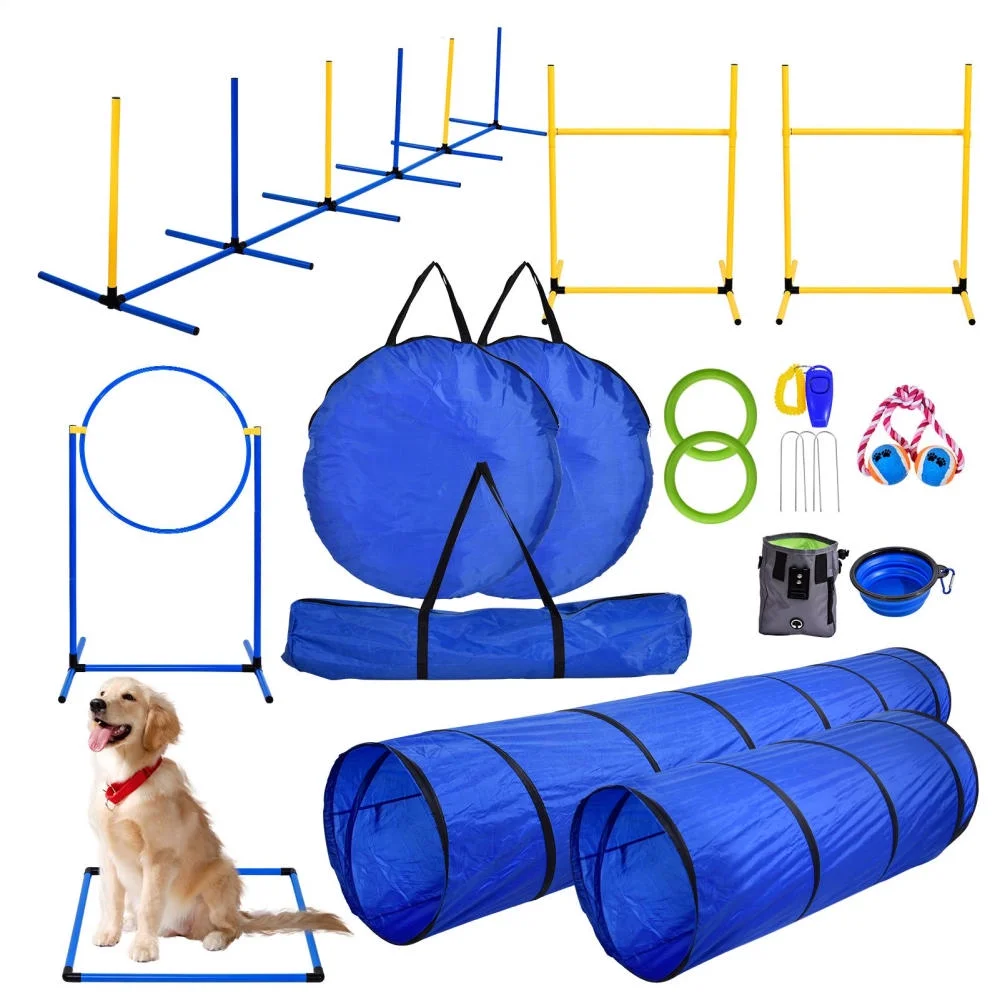
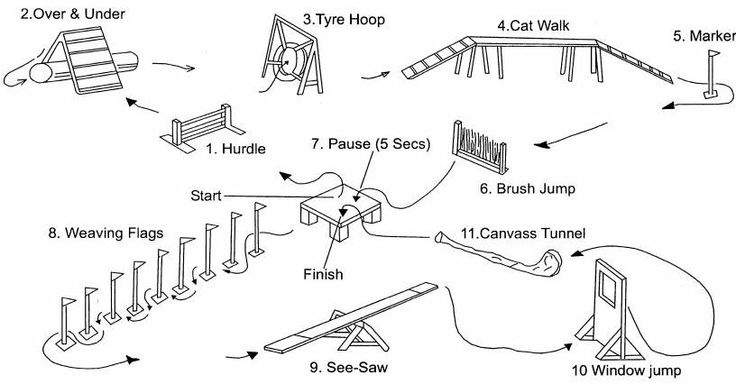
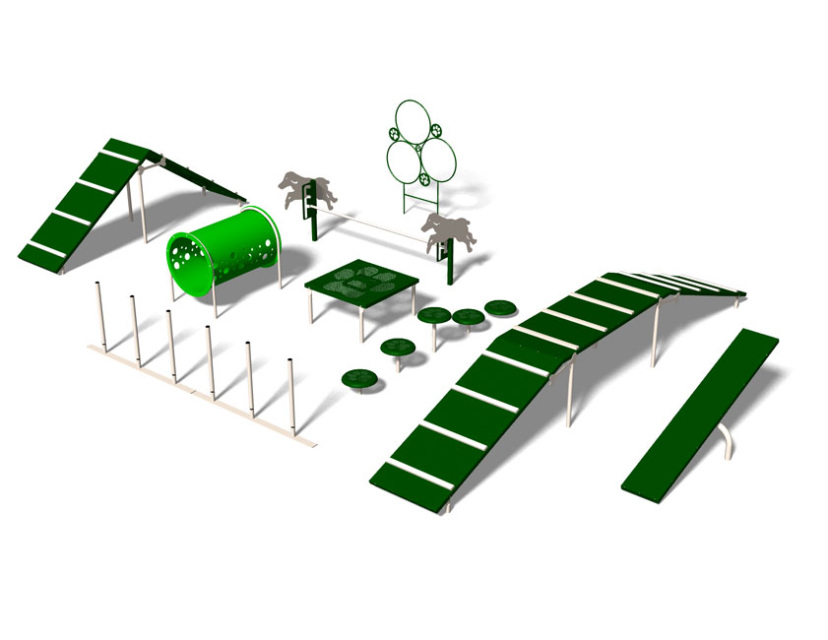
Obstacle work isn’t just about skill—it’s about setup. Luckily, you don’t need a professional agility arena to get started. A few well-chosen pieces of equipment (or a creative afternoon in the garage) are all it takes.
Recommended Equipment:
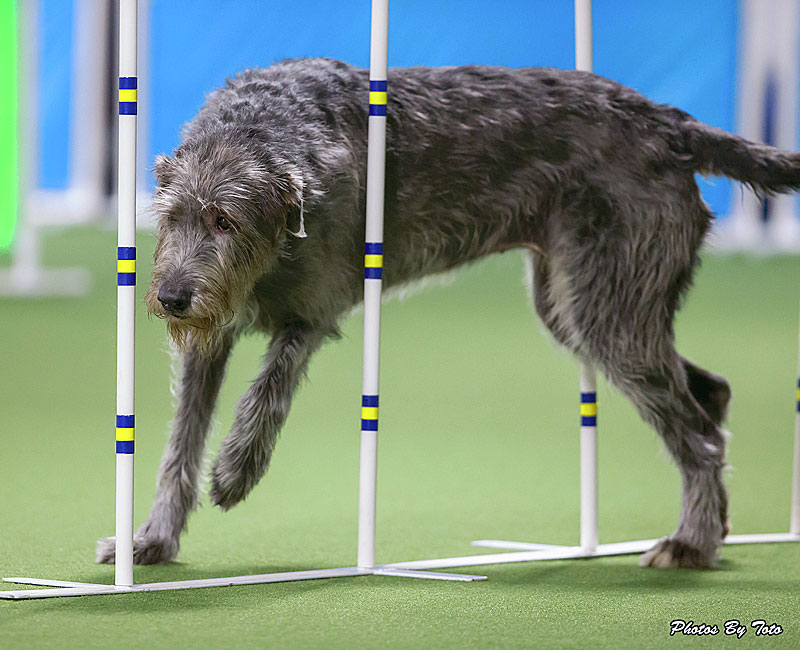
Basic agility cones and weave poles
Low tunnels or crawl-through tubes
Balance platforms or sturdy planks
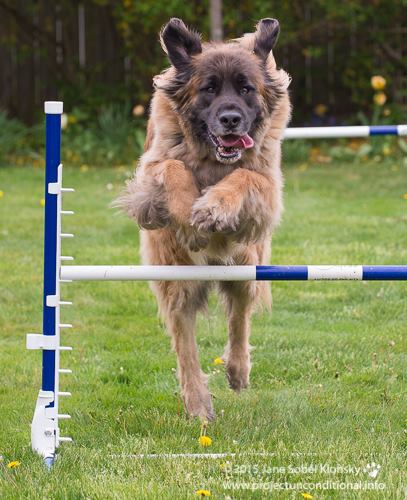
Low jump bars
A-frame or pause box
Reward motivators (treats, tugs, or toys)
Indoor safety mat, turf, or traction flooring
Want the easy route? 👉 Shop our Giant Breed–Approved Obstacle Gear — built sturdy, sized right, and shipped straight to your door. Everything we recommend has been curated specifically for large, slow-to-brake dogs.
Prefer to roll up your sleeves? DIY obstacle building is a fantastic family project. PVC pipes become weave poles. Kiddie tunnels become dog tunnels. Laundry baskets turn into jump supports. If you’ve got a hardware store and an imagination—you’re halfway there.
Whether you build it or buy it, your dog won’t care. They just want to climb something.
🤣Common Challenges & Troubleshooting
Giant breeds are many things—majestic, loyal, powerful—but “eager to follow arbitrary rules” is… not always the vibe.
Here’s what you can expect:
🐌 Issue: Your dog stares at the tunnel like it owes them money
Tip: Never force them. Toss in a treat, shorten the tunnel, or walk through it yourself (you will look ridiculous, and your dog will love that). Some giants simply believe tunnels are optional décor.
🧍♂️ Issue: They go around every obstacle like a polite detour
Tip: Guide calmly, shorten the route, or start with super-simple tasks. Remember: giant breeds are efficiency experts. If the tunnel has an entrance and an exit, why not just… go around?
⚡ Issue: Chaos Mode Activated
Your dog sees the course and decides it’s time for NASCAR. Tip: Slow it down. Soft voice, gentle cues, reset often. Obstacle work is controlled movement—not a demolition derby.
😑 Issue: Sudden existential crisis mid-course
Dog sits down. Looks at you. Decides they’re done. Tip: End the session after a small success. Keep it short. Keep it fun. Praise generously.
💡 Remember:
When a giant breed decides something is pointless… they are unmovable. The secret isn’t force—it’s persuasion, pacing, and humor.
Lifestyle Fit for the Human
Obstacle Work isn’t just a Skill Track—it’s a lifestyle. It suits humans who:
Enjoy physical activity and don’t mind jogging beside 150 pounds of enthusiasm
Love being a “coach” rather than a commander
Find joy in creative outdoor setups
Want a bonding activity that builds trust and teamwork
Can laugh when their dog invents their own “improved” version of the course
If you like seeing real progress, enjoy structured sessions, and appreciate a dog who grows braver and more coordinated over time—Obstacle Work will feel deeply rewarding.
Continuing Education Goals
Once your dog has the basics down, the fun really starts. Here’s how to keep leveling up:
Try fun runs, club events, or demonstrations if your dog enjoys the spotlight
Add scent markers or pattern chains once confidence grows
Practice regular “walk the course” routines to build anticipation and clarity
Consistent, joyful repetition is the foundation of mastery.
🛠️ Bonus Box — DIY Obstacle Ideas for Beginners
You don’t need fancy equipment to get started. Here’s a beginner-friendly list using things most people already have:
Weave Poles: Yard stakes, traffic cones, or filled soda bottles
Jump: Broom handle resting on buckets or cinder blocks
Tunnel: Child’s collapsible tunnel or big cardboard appliance boxes
Crawl Space: Blanket draped over chairs
Pause Box: Painter’s tape square on the ground
Balance Beam: Wide low plank set on bricks
Hurdle Line: PVC pipe angled between garden pots
Safety First: Keep everything low, wide, and stable. Let your dog explore at their own speed. Celebrate small wins—they matter.
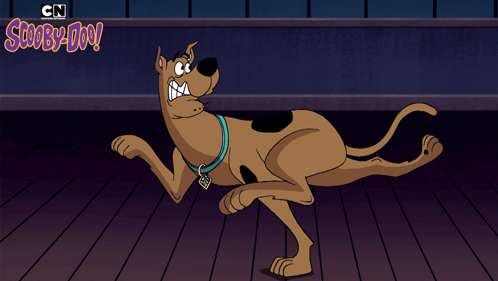
Secret tip: If it wiggles, wobbles, or makes a funny noise, giants often assume it is haunted and needs to be avoided at all costs, remember just how brave Scooby-Doo is? Exactly that brave! Give them time.
Some dogs are born to move. Others live to protect, to guide, or to solve problems—and they feel restless without a role. The Skill Tracks were built to honor that instinct. Each one offers a focused path of continuing education after the First Five and Social Code work are in place.
Hunting Training & Scent work exists because some dogs need more than manners—they need a mission. This isn’t about competitive trophies or social media stunts. It’s about nurturing your dog’s true nature, giving their instincts a safe outlet, and strengthening the working bond between human and giant.
When this Skill Track is done right, it develops a dog’s natural potential while refining the human’s leadership, timing, and emotional connection. It helps the owner understand what “listening” actually looks like—and shows the dog what “being understood” feels like.
And yes, Social Code matters here too. Skill Tracks don’t override temperament—they enhance it. Compatibility with your dog’s Social Code Setting determines whether this Track will be a joy… or a job.
What This Training Develops
Every Skill Track leaves a lasting mark on both dog and human. Here’s what this one build:
Physical: Expect gains in stamina, coordination, and physical confidence. Dogs learn to move with purpose, even though challenging environments.
Mental: Pattern work is the heart of every advanced skill. This Track fosters sustained focus, memory, puzzle-solving, and cue interpretation.
Emotional: Dogs grow in stability, trust, and resilience. A clear training path builds confidence—especially for dogs who tend toward anxious, high-alert, or easily bored states.
This Skill Track aligns most strongly with the following Social Code Settings:
Setting 1: A Safe Place Dogs working scent or hunt tasks must stay emotionally centered. Comfort and predictability build confidence in chaotic environments (fields, woods, etc.).
Setting 2: Mutual Language This Track thrives on subtle feedback. You’ll learn to read ear flicks, breathing changes, and tail posture as much as formal cues.
Setting 3: Bonded Trust Whether trailing scent or flushing game, dogs need the freedom to act—but only if they know you’ll back them up. Trust is what lets them range without disconnecting.
Setting 4: Purpose Path This is a deep instinct for some dogs. When supported properly, scent and hunt work shift from obedience to identity.
🔸 This Track emphasizes Settings 2 and 4 most. Mutual Language builds technical skill. Purpose Path channels natural drive into meaningful work. Bonded Trust develops as teamwork deepens.
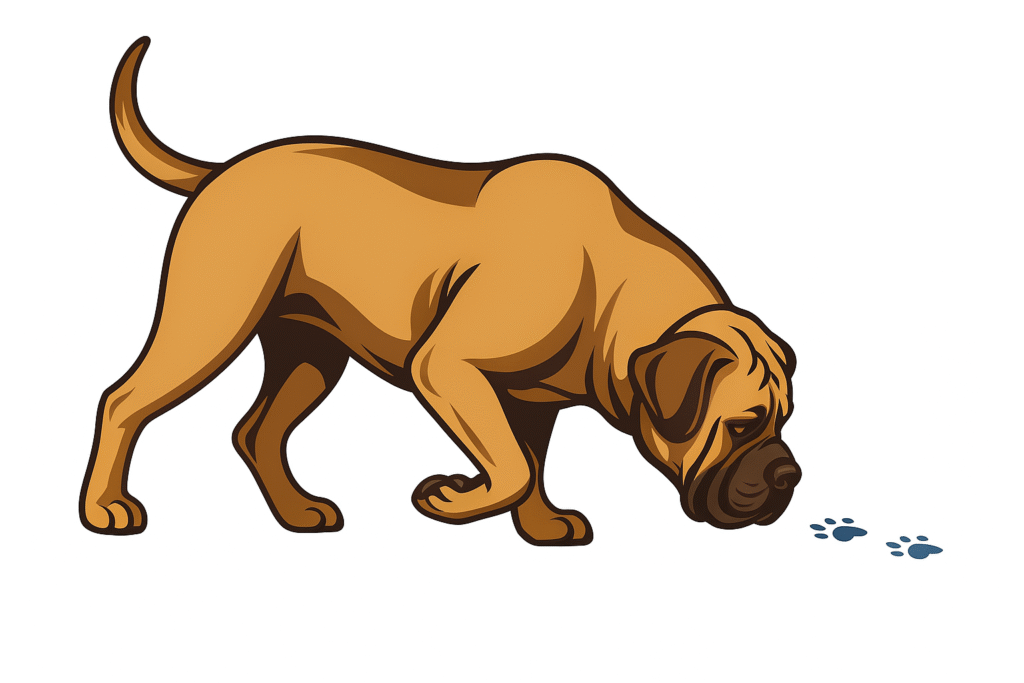
Let’s face it most giant breed of dogs are just not built for hunting, tracking and scent work. But there are always exceptions. We only really have 3 that might like doing this activity as a breed but more than likely it will be that rare 1 in 100 that actually likes to do this kind of work. But we are going to talk about it anyway just so that you know about it as a possibility for keeping your giant engaged.
And we are going to go over this section as if all Giant Breeds are just naturally skilled at this track because who knows your giant baby might just be one of those rare exceptions.
✅ Excellent Fit These breeds are built for this Track, either by instinct, structure, or drive:
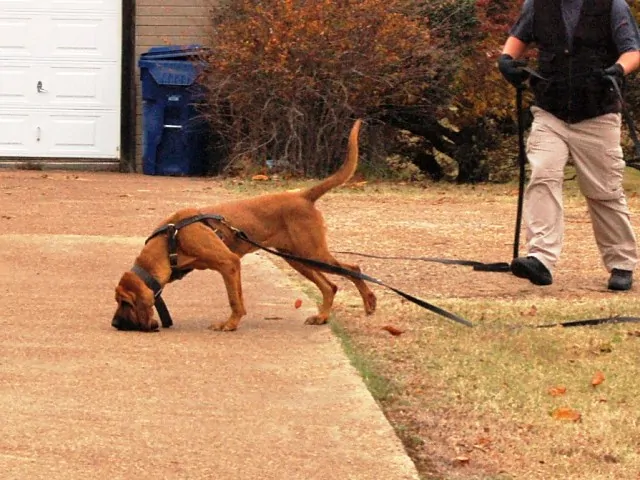
Bloodhound (Not a Giant Breed )
Doberman Pinscher (Not a Giant Breed )
German Shepherd Dog (Not a Giant Breed )
🟡 Good Fit (With Modifications) May enjoy this Track if pacing, environment, or motivation are adjusted:
❌ Not Ideal These breeds are typically mismatched due to temperament, drive, or body type:
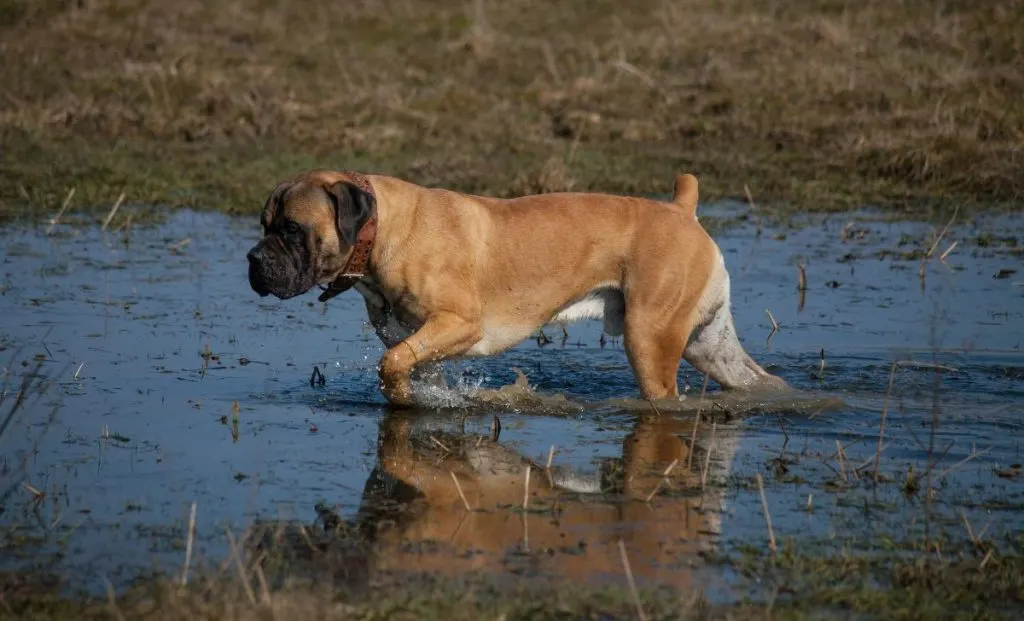
English Mastiff
Irish Wolfhound
All the rest of them
Note: Some low-drive dogs may still enjoy nose-based puzzle games or tracking in limited doses. Let curiosity—not pressure—lead.
Training Goals & Milestones (aka: Let’s Pretend They’ll Do This)
If your giant breed shows even mild interest in sniffing something other than the treat in your hand — congratulations, you are already halfway ahead of expectations. Here’s what “progress” might look like:
Beginner Level
✔ Pairing scent with something exciting (food, toy, your last shred of hope) ✔ Simple hide-and-seek searches in familiar spaces ✔ A recall foundation — or at least them stopping when you yell their name the third time
Intermediate Level
✔ Following a scent trail… for more than eight feet ✔ Offering a “find signal” — sit, bark, paw… or stare at you until YOU go get the thing ✔ Attempting to focus through distractions like wind, birds, or existential reflection
**Advanced Level (The Realm of Fantasy)
✔ Scent discrimination puzzles — because apparently your dog now solves mysteries ✔ Working at distance while you try not to panic ✔ Smooth, silent teamwork like you’re in a spy film instead of a muddy field
Trainer’s note: Sessions for normal dogs might run 30–60 minutes. With your giant beast? Train for as long as they’re interested… or until you give up and pick a different Skill Track that sparks joy.
🔸 Too much scent too soon — Your giant does not need the whole forest to track a biscuit. Start boring. Build slowly. Celebrate tiny wins like sniffing in the correct direction.
🔸 Pressure ruins everything — You can’t make them find the smell. If they fake success by pointing at a tree, take the hint. Reset and try again tomorrow.
🔸 Calm ≠ Disinterest — Stillness may mean deep thought… or a nap. Hard to say.
🔸 Skipping foundation skills — A scent dog without recall is just a wandering horse.
This track is possible — but humility pairs beautifully with a long line and snacks.
Lifestyle Fit for the Human (Because YOU’RE Working Too)
Before signing up for this grand fantasy, ask:
⏳ Time Needed
2–3 practice sessions weekly for normal-sized dogs. For giants? 1–2 sessions and a sense of humor.
🌲 Space & Gear
Field, yard, or living room maze of cardboard boxes. Optional tools: drag line, scent sample jars, your finest bribery treats.
💪 Physical Demand
Some sniffing is gentle. Field work involves terrain, mud, and regret.
☕ Best Human Match
People who like puzzles, patience, and tiny victories. If you enjoy saying “We’re making progress… probably!” — welcome home.
Getting Started (Lightly, Slowly, Carefully… With Snacks)
Gear Basics — Don’t buy $300 level-5 tracking harnesses day one. Start with a collar, a long line, and a dream.
First Session — Keep it short and fun. If you both leave smiling (or panting), that’s success.
Watch Their Reaction — Curious nose = continue. Blank stare = try cheese.
Call a Trainer When Needed — Especially one who understands that your dog is not defective — just gigantic.
Website banner of dog training silhouette
Resources (Because Hope is a Skill Too)
We know you’re here because deep inside, you believe your giant might be the one. Not the fastest, not the sharpest, definitely not the most aerodynamic — but the one who could track a scent… if the spirit moved them.
Below are resources that may nurture that spark into a flickering torch:
📚 Training Guides & Articles
Intro to Tracking — How to lay trails, read dog body language, and celebrate half-successes.AKC Scent Work Foundations — The official basics, for when you want to pretend you’re training a Border Collie.
🎥 Beginner-Friendly Video Trainings 4. Scent Work at Home (YouTube) — Start with boxes, treats, and comedic patience. 5. Tracking on Trails — Step-by-step visuals for when your dog wanders into the creek instead. 6. Signal Training Tutorials — Teach your giant how to tell you they found something instead of just standing beside it.
Teaching dogs the ‘find it’ scent game
How to teach your dog BEGINNER scent detection / nose work
How to Train Your Dog for Scent Work (Nosework) in 3 Easy Steps
Scent Training for Dogs – Tracking Vs Trailing with Jeff Shettler
Training Dog to Track Wounded Deer: Bring Out Their Natural Ability!
🤝 Communities & Support Networks Facebook Groups for Nose Work & Tracking — Where people will cheer with you when your dog succeeds for 4 whole seconds. Scent Trial Clubs & Meetups — See real working dogs, get inspired, then go home and try to recreate the magic. It might work. Maybe.
More will be added as we find giant-friendly adaptations. Because every big dog deserves a chance to sniff with purpose, even if the purpose is unclear to everyone involved.
A Toast to Possibility & Good Humor
The Hunting & Scent Work Skill Track isn’t just about teaching your giant to follow a smell — it’s about believing they might want to.
Some dogs sprint after game like they were born for it. Your giant… may jog politely five steps and then wait for snacks. And that’s okay.
What matters is the connection — the joyful moment where you and your dog share a small victory, like successfully locating a hidden treat or tracking that squirrel for almost ten feet.
Your dog doesn’t have to be great at this. They just have to try — and you just have to laugh with them along the way.
If they complete the First Five Basics and you’re left asking, “What now?” — you’re already halfway there. Not every dog wants to chase deer through the brush. Some want to sniff a leaf, stare into the horizon, and then go home to lie on the AC vent like royalty.
But if your dog lights up at a scent trail, if they pause, nose lifted like they’re thinking, give them the chance.
This could be your track. Not because it’s perfect — but because it’s yours together.
Let their nose lead. Let your patience stretch. And let this be the adventure where you both discover who they might become — and who you become beside them.
Seizures in dogs can be frightening to witness — especially in giant breeds, where their size and strength make the episodes even more dramatic. While the experience can be overwhelming, understanding what’s happening during a seizure, recognizing early warning signs, and knowing how to respond can make all the difference in your dog’s safety and well-being.
What Is a Seizure in Dogs?
A seizure, also called a convulsion or fit, is a sudden, uncontrolled burst of electrical activity in the brain. This abnormal activity temporarily disrupts normal communication between brain cells, leading to changes in movement, behavior, and sometimes consciousness.
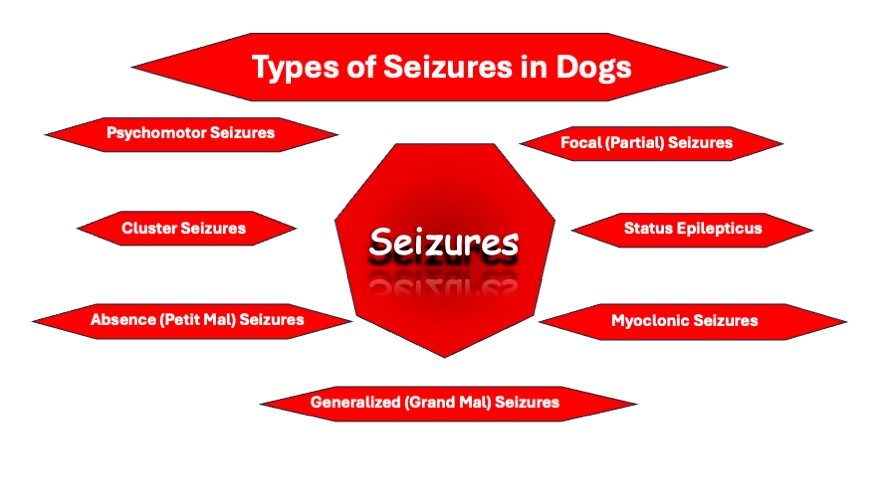
Seizures in giant breeds can have various causes — from epilepsy to underlying illnesses, head trauma, toxin ingestion, or even metabolic disorders. They are generally grouped into several types:
Types of Seizures in Dogs
Generalized (Grand Mal) Seizures – The most dramatic form, involving the entire body with loss of consciousness, stiffening, and rhythmic muscle contractions.
Focal (Partial) Seizures – Affect only one part of the brain, causing localized twitching, unusual movements, or odd behaviors without full loss of consciousness.
Idiopathic epilepsy (no identifiable cause, often genetic)
Head injury or trauma
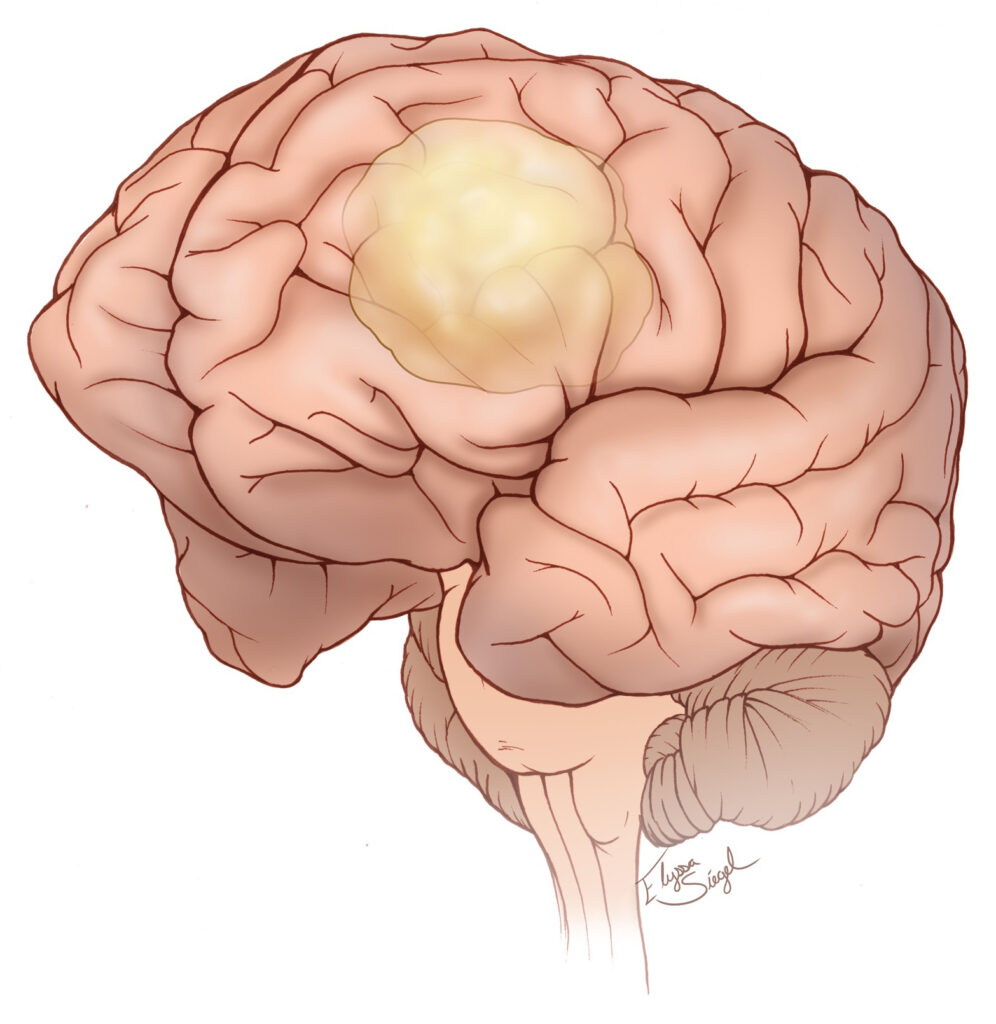
Brain tumors or structural abnormalities
Liver or kidney disease
Low blood sugar (hypoglycemia)
Infections or inflammation of the brain
Toxin exposure (e.g., certain plants, chemicals, or human medications)
Heatstroke
Because giant breeds age differently and often face unique orthopedic and metabolic challenges, their seizure triggers can sometimes differ from smaller breeds.
The Seizure Experience: Walking Through the Phases
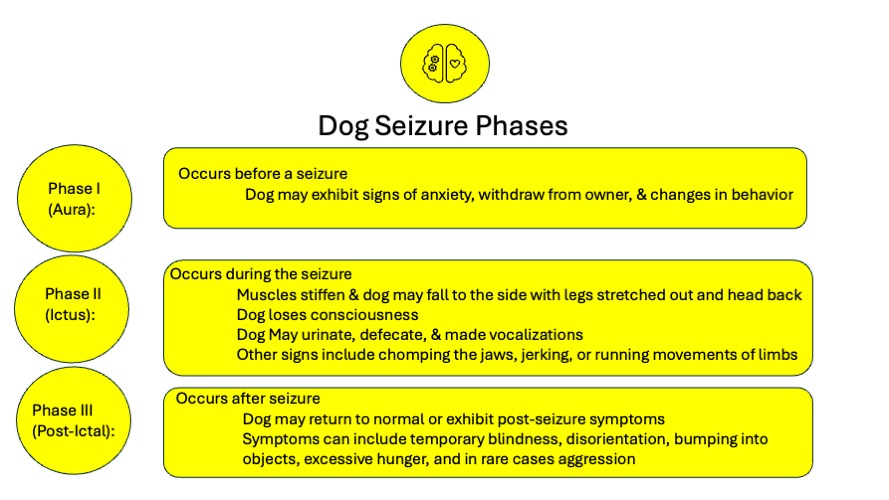
Seizures typically happen in three phases — pre-ictal (aura), ictal, and post-ictal. Understanding these stages can help you act quickly and safely.
Seizures in Dogs
Phase 1: Occurs before a seizure
Dog may exhibit signs of anxiety, withdraw from owner, & changes in behavior
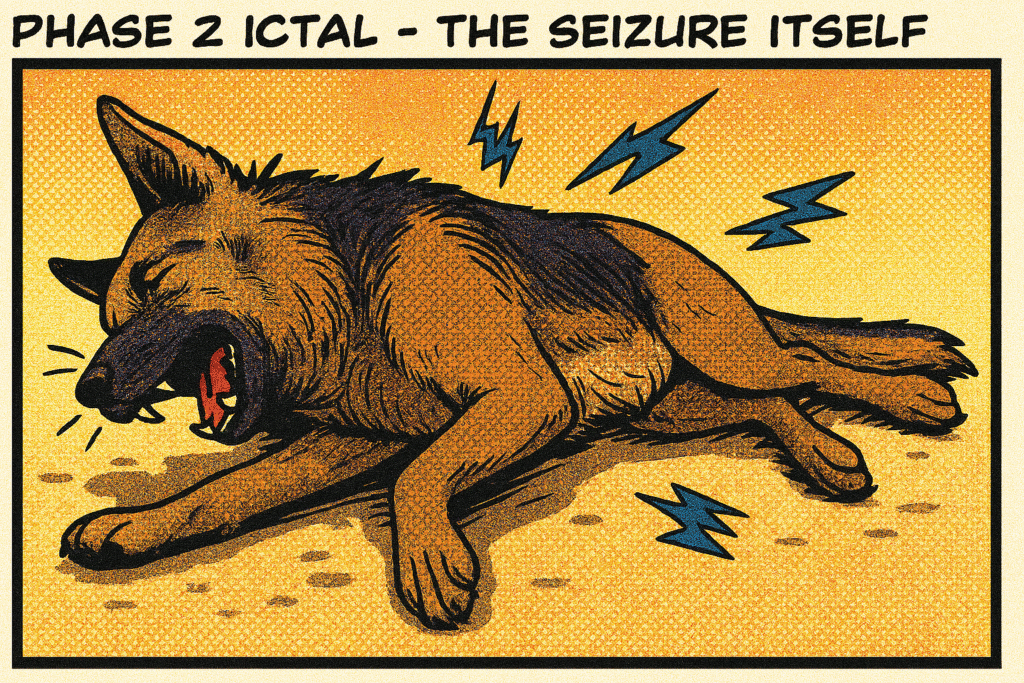
Phase 2: Occurs during the seizure
Muscles stiffen & dog may fall to the side with legs stretched out and head back
Dog loses consciousness
Dog May urinate, defecate, & made vocalizations
Other signs include chomping the jaws, jerking, or running movements of limbs
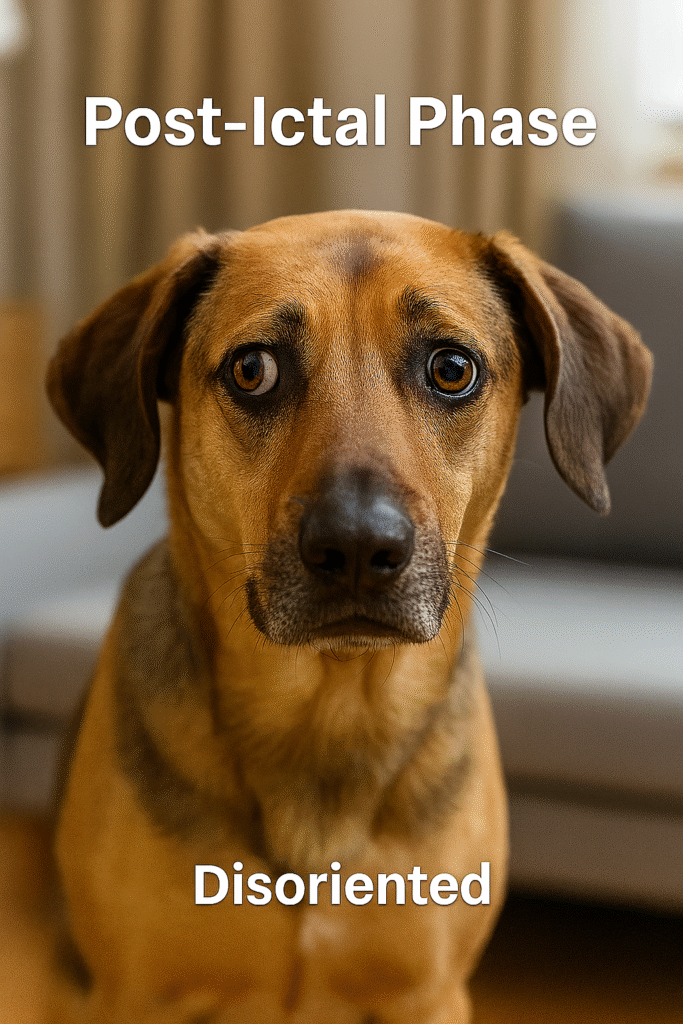
Phase 3: Occurs after seizure
Dog may return to normal or exhibit post-seizure symptoms
Symptoms can include temporary blindness, disorientation, bumping into objects, excessive hunger, and in rare cases aggression
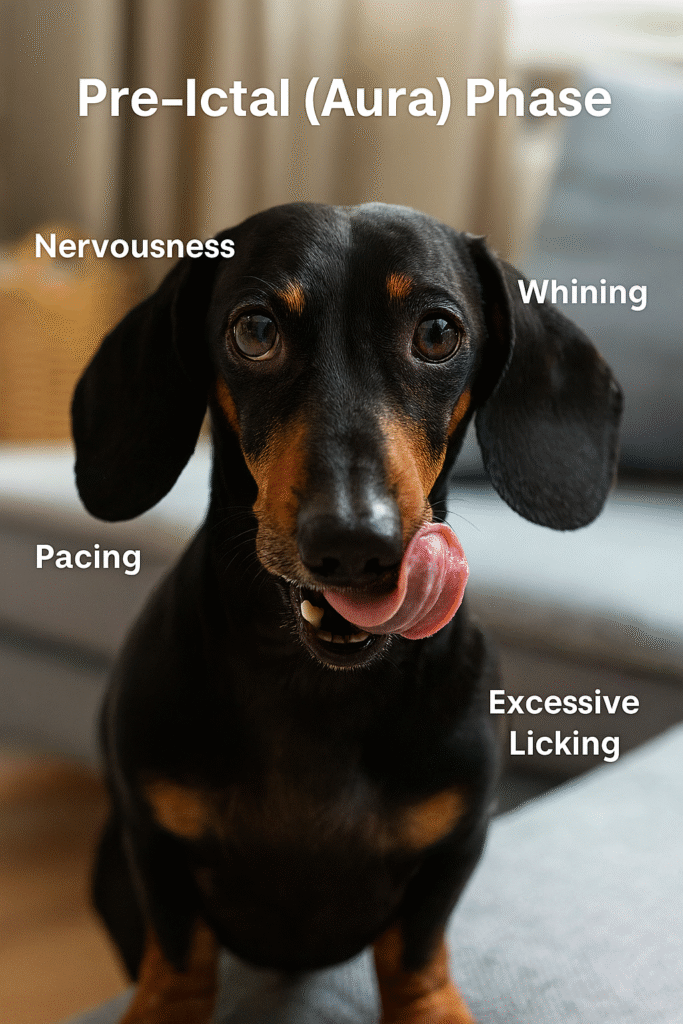
Phase 1: Pre-Ictal (Aura) — The Warning Signs
This phase can last from minutes to hours before the seizure actually begins. It’s your dog’s brain sending early distress signals.
Imagine “Fluffy” pacing restlessly, ignoring your call to come sit. She whines softly and keeps glancing at you with wide, glassy eyes that seem both confused and afraid. She doesn’t want to go outside, but she can’t settle in her bed either. Drool begins to gather at the corners of her mouth. A faint tremor runs down her legs. You might notice unusual behaviors — hiding, clinging to you, or staring off into space.
In this moment, Fluffy may still respond to her name, but you can feel something isn’t right. This is the window where you can prepare a safe space for her and remove nearby hazards.
Phase 2: Ictal — The Seizure Itself
This is the actual seizure event and can last from a few seconds to several minutes, depending on the type.
Fluffy suddenly stiffens and collapses onto her side. Her legs begin to paddle uncontrollably, and her head jerks back. She may lose bladder or bowel control. Her breathing becomes irregular, and her jaw chomps in a rhythmic motion, sometimes producing foam or heavy drool. Her eyes might roll back or flick rapidly from side to side.
This is the most intense and distressing part to watch — but it’s critical you do not try to hold her down or put anything in her mouth. Your job here is to keep her from hitting sharp objects or falling, and to calmly time the seizure.
Phase 3: Post-Ictal — The Recovery Period
When the convulsions stop, Fluffy lies still, her chest rising and falling rapidly. She may appear confused, disoriented, and temporarily blind. Some dogs stumble as they try to stand, bumping into walls or walking in circles. Others may seek comfort from you or hide under furniture. This period can last minutes to hours.
She may be hungry, thirsty, or unusually clingy — all normal as her brain recalibrates. It’s important to keep her safe and quiet during this time and monitor for additional seizures.
Recognizing Seizure Symptoms
Pre-Ictal (Before Seizure)
Restlessness, pacing, or whining
Clinginess or hiding
Confused or fearful expression
Excessive drooling
Subtle muscle twitching
Ictal (During Seizure)
Sudden collapse
Stiffened muscles and convulsions
Paddling limbs
Loss of bladder/bowel control
Heavy drooling or foaming at the mouth
Jaw chomping or chewing motions
Eye rolling or rapid eye flicks
Post-Ictal (After Seizure)
Disorientation or temporary blindness
Stumbling, circling, or walking into objects
Unusual clinginess or hiding
Excessive thirst or hunger
Fatigue or deep sleep
What to Do if Your Dog Has a Seizure
Stay calm — your dog needs your steady presence.
Move hazards out of the way (furniture, sharp objects).
Time the seizure — if it lasts over 5 minutes, call the vet immediately.
Do not put your hands near the mouth or try to hold them down.
After the seizure, keep the environment quiet and dimly lit.
Contact your veterinarian to discuss the episode and next steps.
Bottom line: While seizures in giant breed dogs can be alarming, understanding the phases and symptoms allows you to respond safely and support your dog through recovery. If your dog experiences repeated seizures or any seizure lasting over five minutes, it’s an emergency — seek veterinary care immediately.
Prevention
While not all seizures can be prevented, there’s a lot you can do to lower your dog’s risk and catch problems early. For giant breeds like Fluffy, prevention often starts with routine veterinary check-ups. These visits aren’t just for vaccines — they’re a chance for your vet to spot subtle neurological changes or underlying health issues before they become major problems.
Avoiding head trauma and toxin exposure is critical. That means keeping chocolate, human medications, and toxic plants out of reach, and making sure playtime in the yard or dog park is safe from hard collisions or dangerous drops.
Managing underlying health conditions — like heart disease or hypoglycemia — can reduce seizure risk dramatically. And because excess weight can strain your giant breed’s joints and their metabolic systems, a balanced diet and weight management plan can be a true lifesaver.
Products to Help
Certain products can make a big difference in both safety and quality of life. Padded dog beds and non-slip flooring help reduce the risk of injury if Fluffy has a seizure while moving or getting up. Orthopedic support gear — like supportive harnesses — can help her walk more comfortably during recovery.
For anxious dogs or those prone to stress-triggered seizures, calming aids like thunder shirts or pheromone diffusers can help create a peaceful environment. Meanwhile, home monitoring devices — from simple pet cameras to advanced seizure detection collars — can give you peace of mind when you’re not in the same room. Visit our GiantBreeds Supply Store for products that will help you care for your giant.
Action – Call the Vet
When should you grab the phone? If Fluffy just had her first seizure, if it lasts more than five minutes, or if she has multiple seizures in 24 hours, it’s time for immediate veterinary help.
While you wait for help or head to the clinic, record as much as you can — the duration, the type of movements you saw, any unusual triggers, and how long it took her to recover. Keep emergency vet numbers in your phone and posted somewhere visible at home so no one is scrambling during a crisis.
Veterinary Treatment
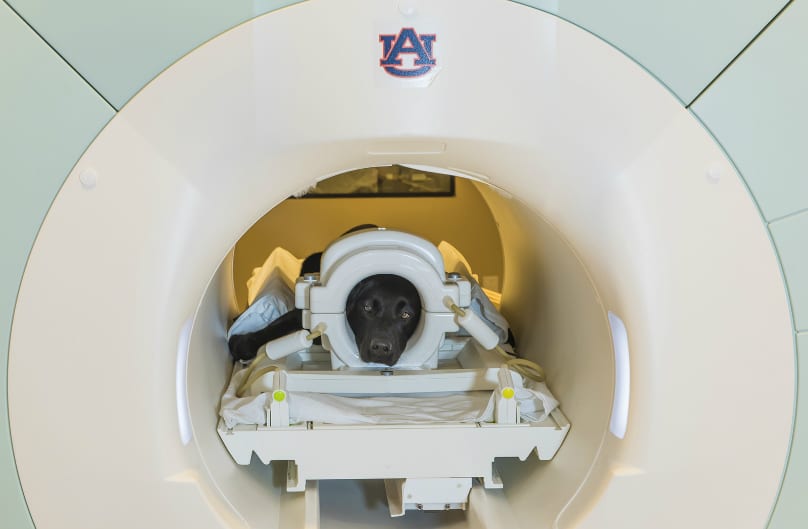
Once you’re at the vet, the diagnosis process may include bloodwork, neurological exams, and possibly imaging (like MRI or CT scans) to look for structural issues. If seizures become recurrent, your vet may prescribe medications such as phenobarbital, potassium bromide, or newer anticonvulsants.
Because giant breeds metabolize drugs differently, side effect management is a big deal — including regular liver monitoring and watching for weight gain. Treatment is highly individual, so your vet will tailor it to Fluffy’s needs and response.
Home Remedies
While no home remedy replaces proper medical care, there are ways to support recovery and safety. Create a safe environment with clear floor space during and after episodes. After a seizure, especially if Fluffy overheats, cooling measures like a fan or cool towel can help.
Offer gentle reassurance with your voice and presence — but never try to restrain her during the seizure itself. Over the long term, nutritional support for brain health — including omega-3 fatty acids and vet-approved supplements — can complement veterinary treatment.
Certain factors make seizures more likely. In giant breeds, age and sex can play a role, with idiopathic epilepsy often showing up between 1 and 5 years old. Environmental stressors like extreme heat, loud noises, or overexertion can also be triggers.
Some metabolic conditions, like hypothyroidism or electrolyte imbalances, occur more often in large dogs, so it’s worth asking your vet about routine screening.
Genetic and Breed Considerations
Some giant breeds, including Great Danes and Bernese Mountain Dogs, have a higher incidence of idiopathic epilepsy. Selective breeding can unfortunately pass on seizure disorders, making genetic screening before breeding an important responsibility for ethical breeders.
Stress and anxiety don’t just affect mood — they can also lower seizure thresholds. Fluffy may be more vulnerable during periods of high stress, such as moving house or after a loud thunderstorm. Post-seizure, she might become clingy or fearful, and gentle desensitization training can help her regain confidence.
Surgical Options
In rare cases, if seizures are caused by a brain tumor or structural malformation, surgery might be an option. For giant breeds, anesthesia requires extra caution — their size, heart health, and breed-specific risks all factor into the safety plan.
Monitoring
The best way to help your vet fine-tune treatment is to keep a seizure diary — noting dates, times, triggers, and recovery details. Schedule regular check-ups and blood tests to track medication effects and consider wearable tech that can log seizure events when you’re not present.
Emergency Contacts
Have a clear emergency plan that includes:
Your primary veterinarian
A 24/7 emergency animal hospital
Pet Poison Control Hotline (ASPCA: 888-426-4435 in the U.S.)
Local epilepsy support groups for dogs, where you can share experiences and resources
Anal Glands (A clear guide for giant-breed owners)
Definition
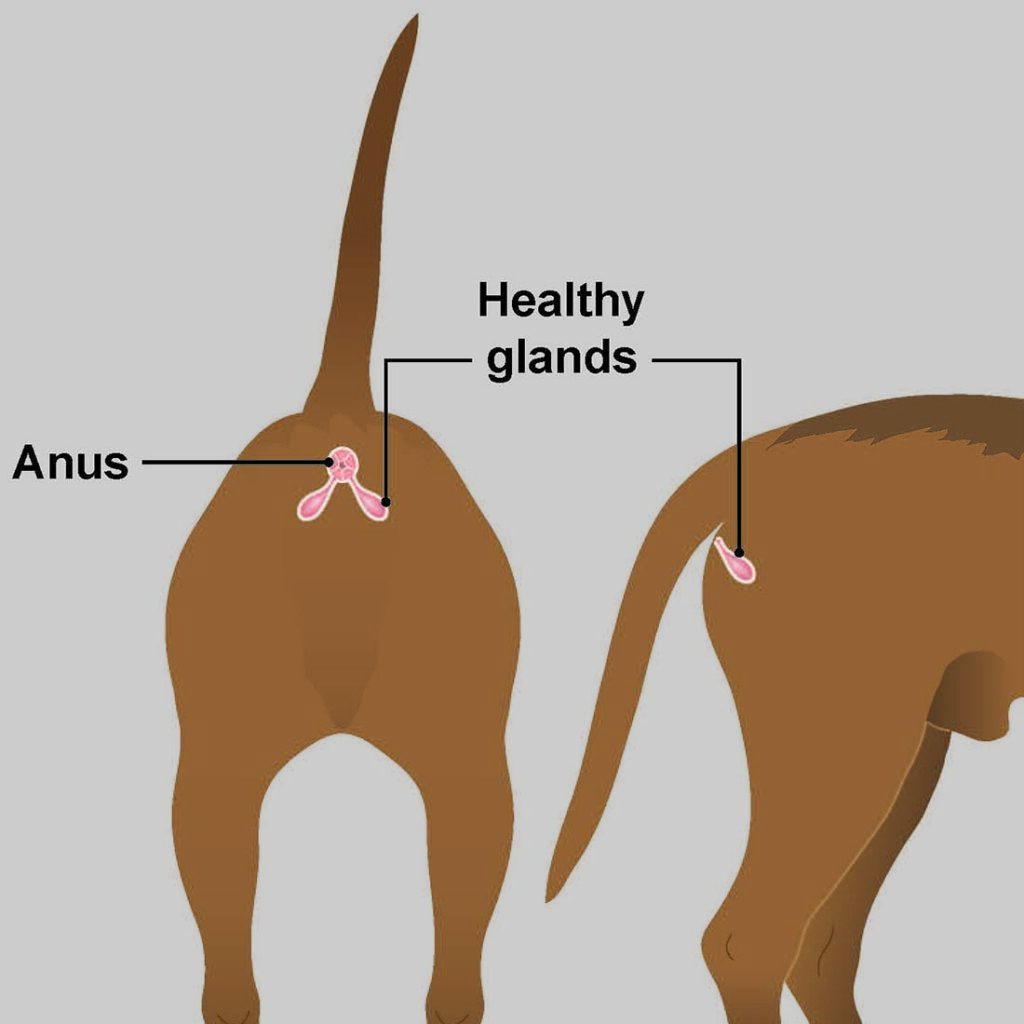
Anal glands (also called anal sacs) are two small pouches located at about 4 and 8 o’clock just inside a dog’s anus. They make a thin, oily secretion used for scent-marking and social signaling. When healthy, these glands empty naturally each time the dog passes firm stools. Problems happen when a gland can’t empty — that leads to fullness, impaction, infection or, rarely, abscess or tumor. For a giant-breed owner, recognizing trouble early matters: the size and strength of a big dog can make management or emergency handling more complicated, and a swollen sac is painful and stressful for the animal.
Symptoms
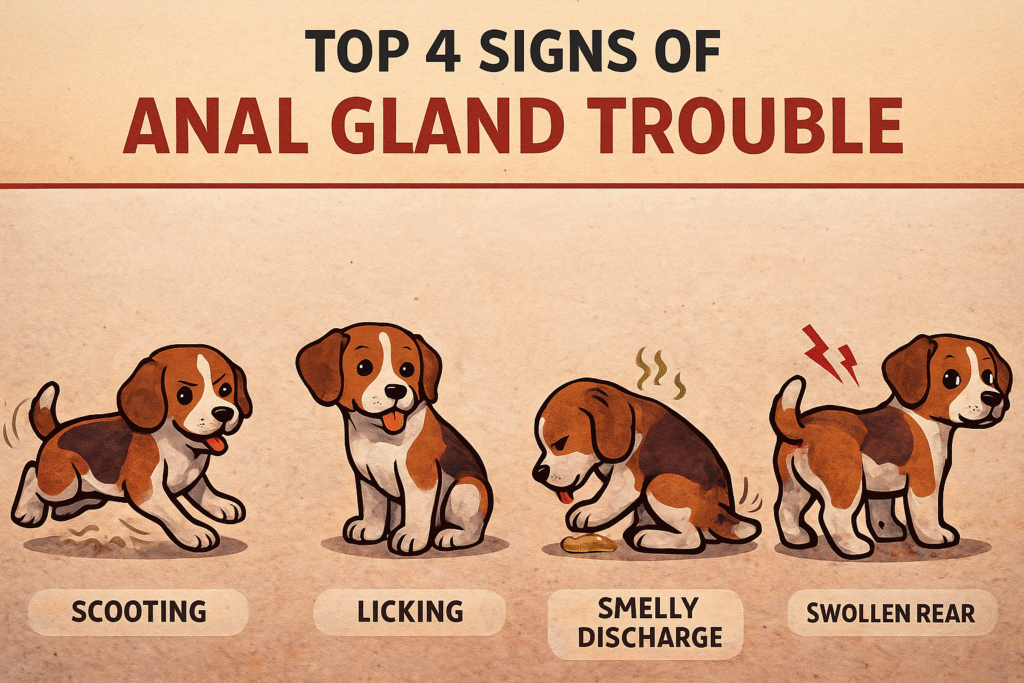
Imagine your dog after a long day: usually calm but today she keeps scooting across the lawn, licking her rear, and yelping when you try to touch her tail base. Sometimes the first sign is subtle — a damp patch on the tail base, a sudden increase in rear-end licking, or changing stool consistency. As the gland fills, the dog may show more obvious discomfort: scooting, straining to defecate, a bad — often fishy — smell, licking or biting the area, and if infection sets in, swelling or redness near the anus and possibly a clear, bloody or pus-tinged discharge. In severe cases a dog may cry out because of pain, become withdrawn, or show signs of low appetite and fever. These are not subtle problems: pain grows, behavior changes, and the dog needs attention.
Prevention
Healthy stool consistency helps the glands empty naturally. Avoid diets that cause chronic loose stools. Keep your dog at an appropriate weight and address recurring diarrhea, allergies, or skin problems that might make them lick and inflame the area. Routine grooming and a quick visual check of the rear after walks or heavy exercise will catch early signs. If your dog has recurring problems, work with your vet on a longer-term plan (diet, fiber, or medical management).
Dog Anal Glands | Vet Explains
Products to Help
There are simple, sensible items that make management easier and less stressful:
A supply of pet-safe wipes for gentle cleaning after outdoor time.
A stool-hardening supplement (dietary fiber like canned pumpkin or psyllium; vet-approved formulations trump random internet remedies).
Topical antiseptic (vet-recommended) for use only when the skin is irritated or after a vet shows you how.
A soft muzzle or gentle restraint for anxious dogs during cleaning visits — only if your dog tolerates it and you use it safely. These tools don’t replace professional care but can keep things comfortable while you arrange treatment.
Call your vet when you notice any of the following: persistent scooting, visible swelling at the rear, bloody or foul-smelling discharge, fever, or obvious pain when you touch the area. If the dog is lethargic, refusing food, or the anal area looks red, hot, or there’s a lump, call now — an abscess can develop and may require emergency care. If it’s a mild, first-time scooting episode, a same-day call is usually fine; if you see swelling, discharge, or the dog is clearly miserable, consider emergency triage.
Veterinary Treatment
Veterinary Treatment At the clinic your vet will examine the glands and may express them manually (often after gentle sedation or local pain control). If the sac is impacted but not infected, manual emptying and a stool-softening/diet plan can be enough. If infection is present, the vet usually prescribes appropriate antibiotics and anti-inflammatories and may flush the sac. Severe or recurring disease may require surgical removal (anal sacculectomy) — effective but with potential complications, so it’s reserved for chronic, refractory cases. In abscessed sacs the vet will often lance and drain the site and give systemic antibiotics; wound care and follow-up are essential.
Home Remedies (safe, limited, and only as interim measures)
Warm compresses applied gently to the area can relieve discomfort while you arrange vet care. Adding a moderate amount of fiber (canned pumpkin or vet-recommended fiber supplement) can firm stools and help natural emptying. Avoid attempting to express a gland yourself unless a vet has shown you the technique — improper expression can cause pain, rupture, or drive infection deeper. Never use human topical antibiotics or unknown ointments without vet approval.
Home Remedies For Dog Anal Gland Smell
Risk Factors
Anal gland problems are more common in dogs with chronic soft stools or diarrhea, obesity, and those with ongoing skin allergies that cause licking and inflammation around the rear. Frequent anal gland disease can also be linked to anatomy, poor muscle tone, or repeated irritation. While small breeds tend to have higher rates of sac disease in general, any dog — including giants — can develop problems. Giant breeds that have chronic constipation or who are sedentary may develop impaction from hard, dry stools failing to press against the sacs properly.
Genetic and Breed Considerations
Some breeds show higher incidence (often small breeds), but heredity is not the whole story. In giant breeds, body conformation, coat type, and skin conditions matter more than simple breed labels. If a particular bloodline shows repeated sac disease, breeders should have that conversation with their veterinarian and consider breeding choices carefully.
Psychological Factors
Pain and discomfort change behavior. A dog with an uncomfortable or infected gland may become clingy, irritable, or defensive when a human approaches the rear area. Reassure and avoid forcing an examination — escalate to the vet rather than escalating stress at home. Conversely, repeated handling for home care (once trained and gentle) can reassure some dogs — the key is calm, consistent handling and a quiet environment.
Surgical Options
Anal sacculectomy (removal of the gland) is the standard surgical option for dogs with chronic, untreatable sac disease. It is effective, but not without risks: incontinence can occur if nerves or muscles are damaged, and healing can be prolonged if the area was recently infected. Because of those risks, surgery is chosen only after reasonable medical management fails and performed by a vet experienced with the procedure. Discuss risks, success rates, and post-op care thoroughly before consenting.
Monitoring
Keep a short log: dates of scooting or licking episodes, stool consistency, any discharge, medications given, and the vet’s actions. A pattern — recurring after certain foods or in certain environments — helps your vet tailor prevention. Weigh your dog periodically; obesity increases risk. After treatment, a follow-up visit ensures the problem is resolved and prevents recurrence.
Program these into your phone under a clear name (or in a Notes field tied to the pet): your primary vet, nearest 24/7 emergency clinic, and a regional vet-hospital that handles surgery. If your dog is on medication or has known chronic issues, keep that list bedside for quick access.
Final Note
Anal gland problems are common, often manageable, and usually not catastrophic when caught early — but they are painful, and they escalate if neglected. For giant-breed owners, the biggest advantage you have is vigilance: regular visual checks, attention to stool quality, and early calls to your vet will keep simple issues from becoming emergencies. If you ever feel unsure, call — your vet would rather manage a small issue than treat an advanced infection.
Guarding and patrolling are natural instincts for many giant breed dogs. These dogs are not only loyal but also protective of their families and territories. Guarding involves watching over a specific area, while patrolling extends that responsibility, often covering larger spaces or monitoring different zones. When these dogs feel a strong bond with their owners, they naturally become protectors, looking out for the safety of their pack. Guarding and patrolling are built on trust, loyalty, and emotional bonds, and when correctly nurtured, these dogs can become reliable, alert protectors.
Guarding isn’t about unnecessary aggression; it’s about ensuring safety and giving their family a sense of security. Understanding your dog’s personality and the natural instincts that come with their breed is key to fostering a balanced guardian.
The “First Five” Basics & Social Codes
Before you dive into specialized guard training, it’s essential to build a foundation of basic obedience skills. The “First Five” (sit, stay, come, heel, down) should be second nature for your dog. These commands will help you maintain control during guarding exercises and ensure your dog is calm and focused when needed. Social codes are equally important—these are the non-verbal ways dogs communicate with each other and with us. They understand body language, gestures, and other subtle cues, which are crucial when you’re trying to build a calm, disciplined guardian.
When introducing guarding behaviors, it’s important to establish clear boundaries. The goal is not to create a dog that reacts impulsively, but one that knows when to be alert and when to stay calm. Through consistent training, you will teach your dog when to guard and when to relax, ensuring that they aren’t unnecessarily stressed or overreactive.
The instinct to protect is rooted in a dog’s love for their pack. Giant breed dogs, in particular, form deep bonds with their families and homes. Once they trust and love their owners, the instinct to guard becomes automatic. This loyalty doesn’t just extend to the human family members, but also to any pets or other people the dog perceives as part of the pack. It’s essential to understand that while some dogs may naturally protect their family, others may also view extended family, like neighbors, as part of their pack.
Understanding the emotional connection your dog has to you and your home is key to fostering a safe and effective guardian. With trust, love, and consistent training, your dog will become a reliable protector, always on the lookout for any threat to their pack.
Guard Training & Its Many Styles
There are many styles of guard training, and the style you choose depends on what you want your dog to do. Some people want a dog that provides a visible deterrent, while others may want a more active guard that intervenes when needed. It’s important to think about what kind of guard dog you want before starting training. Will you want a dog that barks loudly to alert you? Or one that remains quiet but protective? Will your dog be an active protector, or more of a silent guardian who remains calm and vigilant?
Remember, the training should always be based on trust between you and your dog. Guarding training is not about teaching your dog to be aggressive; it’s about developing their natural instincts in a controlled, safe environment.
There are several myths surrounding guard dogs, especially giant breeds. One common misconception is that these dogs cannot be trusted around children. In reality, a Dogo Argentino or a Cane Corso, when raised correctly, will see the children in the home as part of their pack and will protect them fiercely. The key is raising these dogs in a way that promotes trust, not fear.
Another myth is that all guarding dogs are aggressive. A well-trained guard dog is calm, controlled, and focused, not aggressive or unpredictable. The goal is to create a dog that responds appropriately to threats, not one that attacks without reason.
Special Considerations & Challenges
While guarding behavior can be an asset, it does come with challenges. One of the most common issues is over-barking or a dog misjudging situation. Early socialization is crucial to help your dog differentiate between a real threat and a harmless situation. Guarding behaviors can also lead to territorialism, where your dog may react aggressively to strangers or other animals in what they consider their territory.
As a giant breed owner, patience and consistency are key. Understanding the unique challenges your dog faces will allow you to manage their guarding instincts effectively. Regular training and clear boundaries will help mitigate these challenges, ensuring that your dog is a well-behaved and reliable guardian.
Patrolling: The Mindset of a Dog
Patrolling, in the canine world, refers to the act of moving around a defined area, monitoring it for any potential threats or changes. It’s different from guarding, which is more stationary and focused on protecting a specific area or group. Some dogs, like the Great Pyrenees, are natural patrollers. They are alert, roam their territory, and keep an eye on anything that might be out of place, especially at night when their instincts are most active. Their role is to protect, not just what’s within their immediate reach but also the area surrounding them, including their human family.
On the other hand, some giant breeds, like the Great Dane, are more pack-oriented. They stay close to their people, preferring to guard rather than patrol. This pack mentality means that the dog will protect their human family by staying with them and ensuring no harm comes to them. Their focus is on the safety of their immediate environment rather than roaming around. Though still protective, they don’t typically roam as part of their duty.
Understanding the difference between a territorial mindset and a pack-oriented mindset is key to understanding your dog’s patrolling behavior. Territorial dogs, like the Great Pyrenees, feel the need to patrol and establish boundaries around their living space. Their natural instincts drive them to roam and guard that space from threats. In contrast, pack dogs like the Great Dane will focus on the immediate family or pack, and they won’t feel the need to patrol larger areas, focusing instead on safeguarding their pack.
A beautiful example of this dynamic can be found in a story of a woman living in a Yurt in the desert with her two dogs— a Great Dane and a Great Pyrenees. The Dane stayed close to her, always by her side, protecting her as a part of his pack. Meanwhile, the Pyrenees would roam at night, patrolling the area, alerting his family of anything amiss. This cooperation between the two breeds exemplified how the balance of a territorial dog and a pack-oriented dog can work together, creating a dynamic safety system where both types of protection thrive.
Recommended Tools & Training Aids
Training a guard dog requires the right tools and aids to ensure their success. Here are some essential items:
Sturdy harnesses and long leads for control during training
Training collars (only with professional guidance)
Bite pillows or sleeves for practice
Interactive toys for engagement
Training books or online courses for step-by-step guides
These tools will help you guide your dog through their training, ensuring they remain focused and responsive to commands.
Some giant breeds are naturally more suited to guarding and patrolling due to their instincts and physical capabilities. The following breeds excel in guarding roles:
Some dogs were built to move—not just in the sense of covering ground, but in the art of how they move. They leap, pivot, dart, and weave with a kind of joy that feels ancestral, like they were born solving problems with their feet. And some owners? They recognize that spark. They know a dog with energy isn’t just a handful—it’s a potential partner, waiting for purpose.
Agility training is the Skill Track for dogs who thrive on motion and for owners who are ready to turn that motion into meaning. At its core, agility is a structured, confidence-building physical and mental challenge. It’s not just about weaving poles and jumping hurdles—it’s about precision, communication, and trust under pressure.
For owners, agility provides more than just a tired dog. It builds a bond. It creates a shared language. It unlocks a new way to lead and listen. For dogs, especially giant breeds who are often underestimated in this arena, agility gives them pride in motion. A sense of direction. A way to rise.
This article helps you figure out if agility is the right Skill Track for you and your dog—not just based on breed, but on how your dog naturally engages with the world, using our Social Code framework.
What This Training Develops
Every Skill Track teaches something different. Agility teaches your dog to listen fast, move smart, and trust deeply.
Here’s what agility training fosters in your giant breed:
Physical Development
Precision jumping and foot placement
Balance and coordination over unstable surfaces
Muscle tone and cardiovascular endurance
Mental Development
Pattern recognition and memorization of course sequences
Split-second decision-making
Self-control in the face of excitement
Emotional Development
Confidence through repeated problem-solving
Resilience when mistakes happen
Bonded trust between dog and owner under stress
Agility aligns with several key Social Code Settings, including:
Setting 2: Mutual Language – Your dog learns to respond quickly and accurately to subtle cues.
Setting 3: Bonded Trust – Your dog gains confidence by mastering new challenges with you as their steady partner.
Setting 4: Purpose Path – Your dog has a job that’s mentally stimulating and physically satisfying.
Social Code Compatibility: Who This Skill Track Is For
Training isn’t one-size-fits-all—and neither is how dogs connect with the world around them. This section shows how agility fits into our Social Code, giving you a map to decide if this Skill Track aligns with your dog’s instincts.
Setting 1: A Safe Place
While agility training itself isn’t about the home, it requires a foundation of safety and obedience at home. Dogs who understand crate training, leash rules, and basic commands will thrive in agility—because they already trust the structure you provide.
Setting 2: Public Spaces
Agility sharpens your dog’s ability to work with you under distraction. Whether you’re navigating a crowded park or just walking downtown, the focus and impulse control taught in agility transfers directly to real-world public behavior.
Setting 3: Heightened Awareness
When your dog’s instincts kick in—excitement, fear, alertness—agility provides a structured outlet. Instead of spiraling into chaos, your dog learns to channel that energy into listening. This setting is crucial for breeds that startle easily or get overexcited.
Setting 4: Navigating Social Challenges
Agility courses often introduce new environments, loud noises, and unexpected turns. With repetition and support, your dog builds the kind of calm courage needed for vet visits, family holidays, or even just a trip to the hardware store. It’s a safe way to practice bravery.
Giant Breeds That Fit This Skill Track Best
Not all giants move the same way. Some leap before they look. Others calculate every step. Agility rewards focus, drive, and physical ability—but it also builds all three. These are the breeds best suited for agility work, based on their temperament, structure, and how they naturally align with the Social Code.
✅Excellent Fit (Natural Agility with Drive)
These breeds are nimble, responsive, and thrive on fast-paced, purpose-driven tasks:
Great Dane– Despite their size, they’re surprisingly agile when bonded and motivated.
Irish Wolfhound – Swift and observant, they do well with pattern work and develop confidence through movement.
Leonberger – Eager to please and physically capable, especially when started young.
Boerboel – Muscular and driven, does well with short, intense focus drills. Needs mutual respect to shine.
Cane Corso – Strong impulse control when trained properly. Agility sharpens their already tuned instincts.
🟡 Good Fit (With Modifications or Focus Work)
These breeds can do well in agility, but need tailored approaches or extra foundational work:
Tosa Inu– Needs trust and strong foundational work first. Excels when bonded.
English Mastiff – May not love speed, but benefits from problem-solving courses built around slower patterns.
Neapolitan Mastiff – Structurally slower but emotionally benefits from confidence-building exercises.
🟡 Not Ideal for This Skill Track (But Excellent Elsewhere)
These breeds often find more joy in calmer, task-based Skill Tracks (like Guarding, Compassion, or Herding):
Saint Bernard – Built for endurance, not rapid pivots. Better suited for water rescue or emergency response.
Tibetan Mastiff – Independent thinker with low repetition tolerance. Prefers patrol or guarding work.
Great Pyrenees – Nocturnal and slow-moving by instinct. Better in solo jobs where they control the pace.
Anatolian Shepherd – Strong-willed with limited agility interest; shines in boundary and protection roles.
Training Goals & Milestones
Agility is a journey in stages. Not every giant breed will sprint out of the gate. But with commitment, every dog can reach milestones that matter.
Beginner Goals
Build the foundation: trust, response, and simple coordination.
Mastering basic obedience under distraction
Introduction to equipment (jumps, tunnels, ramps)
Building excitement around coursework through games
Leash work transitions into off-leash pattern beginnings
Social Code Setting 2: Responding in public spaces
Social Code Setting 3: Developing bonded trust through teamwork
Breed notes:
Great Danes and Leonbergers often take to beginner agility easily if started early.
Boerboels need clear leadership and encouragement—don’t rush them.
Beginner’s Guide to Dog Agility
Intermediate Progression
Focus, patterns, and increasing physical demand.
Off-leash work on full beginner course
Sequencing 3–5 obstacles
Building speed without losing form
Working in new environments with novel stimuli
Social Code Setting 4: Facing new challenges with owner as guide
Great Danes Agility JWW Excellent
Advanced Mastery or Specialized Roles
Course fluency, competitive readiness, or specialized emotional outcomes.
Competing in agility events or exhibitions
Creating custom challenges for enrichment
Using agility as behavior therapy (for anxiety, over-arousal, or nervous energy)
Full synchronization with owner cues, including silent commands or gestures
Combining agility with other Skill Tracks (e.g., scent work or emergency response)
Breed notes:
Irish Wolfhounds may never be the fastest, but their rhythm and calm awareness make them striking in advanced performance.
Cane Corsos can develop deep confidence and self-control through long-term agility work.
OneMind Dogs – Advanced backyard agility skills!
Products That May Help (Tools for the Agility Skill Track)
Getting started with agility doesn’t require a professional course. Many of the best tools are simple, adaptable, and designed with giant breeds in mind.
🧰 Foundational Training Gear
Long Lines (15–30 ft) – Practice distance cues and build trust without losing control
High-visibility Target Mats – Teach position, stay, and entry points for patterns
Treat Pouches / Hands-Free Belts – For quick, consistent rewards during movement
Adjustable Martingale or Biothane Collars – Secure but flexible under motion.
Extra-Wide Tunnels – Durable enough for heavy dogs, collapsible for storage
Low Impact Jumps with Safety Release Bars – Minimize joint strain while practicing form
A-Frames with Traction Surfacing – For strength training and confidence
Weave Pole Kits with Wide Base Stabilizers – Prevent tipping with heavier dogs
Dog Walk Platforms (Wide & Textured) – Balance practice with safer footing.
💡 Training Aids & Enhancers
Clickers or Verbal Marker Tools – Reinforce instant successes
Cooling Vests or Mats – Help regulate temperature post-workout
Joint Support Supplements – For breeds prone to hip or elbow issues (glucosamine, chondroitin, etc.)
Paw Wax or Booties – Protect against rough surfaces or cold-weather courses
Common Mistakes & Misfits
Just because a dog can do something doesn’t mean they should. Agility is beautiful when it matches the dog’s instincts and body. But when owners push too fast or pick this Skill Track for the wrong reasons, it can lead to burnout, frustration, and even injury.
🟠 Common Mismatches:
Expecting a slow-thinking guardian breed to navigate obstacle courses like a herding dog
Choosing agility because it “looks cool” on social media—rather than it fitting your dog’s personality
Trying to force obedience without earning mutual trust first
⚠️ Over pushing the Dog:
Starting high-impact exercises before your dog is physically ready
Training on hard surfaces, narrow spaces, or high jumps without adjustment for size
Mistaking nervous compliance for engagement—watch for tail position, eye contact, and pace
🚩 Ignoring the Social Code:
If your dog hesitates before entering a tunnel or avoids an obstacle, that’s Setting 1: Safety speaking
If your dog stops responding to commands mid-course, they may be overwhelmed Setting 3: Overarousal
If training turns into tension, you’re no longer aligned with Setting 4: Navigating Challenges Together
Lifestyle Fit for the Human
Agility training doesn’t just shape your dog—it reshapes your life. This isn’t just a Skill Track. It’s a shared practice that asks more of the human than most people expect.
🕒 Time Commitment:
15–30 minutes, 3–5 days per week for steady progress
Extra time for setup, warm-up, and cool-down—especially with giants
Weekend events or training groups, if you want to compete
💪 Physical Demands:
You’ll be moving too running beside your dog, practicing cues, adjusting equipment
Requires bending, walking fast or jogging, and sometimes carrying equipment
Owners with mobility issues may need assistance setting up or choose a different Skill Track
🏡 Environmental Needs:
A yard or access to safe open space is ideal
Indoor space for rainy-day drills or targeting games
Storage space for foldable equipment if practicing at home
🧠 Recommended Human Personality Traits:
Patience – Progress may be slow, especially with cautious breeds
Consistency – Repetition is your best friend in agility
Engagement – Dogs mirror your energy; your enthusiasm builds theirs
Calm Assertiveness – When your dog hits a wall (literally or emotionally), your stability matters
Getting Started: How to Begin This Skill Track
You don’t need a professional trainer to start agility. You need a plan, patience, and a promise to work with—not on—your dog.
🧰 Basic Equipment or Setup:
1–2 beginner-friendly obstacles (e.g., a hoop, tunnel, or low jump)
A long lead and high-value treats
A flat, non-slip training surface (grass, dirt, or soft flooring)
🚦 First 3 Training Steps:
Lure and Reward: Guide your dog through or over one obstacle using food or toys
Add a Cue: Use a consistent word (“tunnel,” “up,” “go”) right before movement
Reinforce Calm Repetition: Reward slow, confident approaches just as much as quick ones
🔍 Reading Your Dog’s Feedback:
A dog that circles the obstacle or freezes needs more confidence (Setting 3)
A dog that rushes through and looks back is asking “Was that right?”
A dog that disengages entirely may not be in the right Skill Track—or may need rest
🙋 When to Seek Professional Help:
If your dog shows stress signals (panting, tail tucking, refusal) repeatedly
If your physical space is limited and you need ideas for custom training
To join group classes or competitions for structured learning
Resources
You don’t have to do this alone. Whether you’re training in your backyard or aiming for a title, here’s how to keep growing.
📦 Gear Recommendations:
Starter Agility Kits (giant-breed rated) – With oversized tunnels, jump bars, and weave poles
Anti-slip Flooring Mats – Ideal for garage or basement setups
Biothane Leashes – Easy to clean and non-slip for outdoor drills
Treat Pouches & Clickers – Help keep your cues consistent
🎥 Training Videos & Communities:
YouTube: “Agility Foundations for Large Dogs” series
Reddit: r/dogtraining – threads on large breed agility setups
Facebook Groups: “Giant Breed Agility Enthusiasts,” “Slow & Steady: Agility for Big Dogs”
📘 Breed-Specific Agility Tips:
See full below for breed profiles and custom training adjustments
Check for breed clubs or working dog groups with agility branches
Some rescue organizations offer agility-based enrichment programs
A Path With Purpose
Every dog is waiting for their “why.” Agility training doesn’t just give your giant breed something to do—it gives them a rhythm, a voice, a way to grow alongside you. It’s not about speed or scores. It’s about bonding through movement, challenge, and shared triumphs.
Whether you’re guiding a Cane Corsos through a slalom or helping a cautious Mastiff conquer a tunnel, you’re not just training behaviors. You’re giving your dog purpose. And that, in the world of giant breeds, is everything.
Despite their size, Great Danes possess a natural elegance and surprising nimbleness. Their long stride and athletic structure allow them to glide through wider agility setups, especially outdoor courses with ample space. While their bursts of energy are often short-lived, they respond exceptionally well to concise, low-impact agility routines that stimulate without overstressing their joints. Agility work also gives these sensitive giants a sense of communication (Social Code Setting 2: Mutual Language) and helps reduce separation-related behaviors by giving them purpose (Setting 4: Purpose Path).
Irish Wolfhounds may not be the fastest at weaving poles, but their calm presence and eagerness to connect with their owner make them ideal for agility that builds confidence. Low-impact, steady-paced agility encourages coordination and decision-making without overwhelming their natural reserve. These gentle giants excel in confidence-building challenges that foster trust (Setting 3: Bonded Trust) and deepen the dog-human partnership.
Leonbergers are powerful, agile, and responsive making them one of the top candidates for agility work among giant breeds. They thrive on structure and respond beautifully to training that balances physicality with positive reinforcement. Agility taps into their working heritage, develops impulse control, and satisfies their strong desire to please. This breed often shows rapid progress in obstacle-based pattern work, aligning naturally with Social Code Settings 2, 3, and 4.
Boerboel: Focused and Steady
Boerboels bring a focused energy to agility training. While not the fastest, they are incredibly strong, balanced, and precise when properly conditioned. These dogs benefit from clear structure and repetitive pattern work that builds impulse control. Agility helps manage their guarding instincts by redirecting alertness into purposeful tasks (Setting 4), while increasing cooperation and cue response (Setting 2). Owners must take care to avoid overexertion and adapt the course to the dog’s muscular frame.
The Cane Corso may not seem like an agility dog at first glance, but their intelligence and responsiveness make them capable of mastering well-paced, strength-focused agility setups. They are naturally observant and strategic, and agility helps refine those traits into structured, responsive actions. Working in close partnership fosters trust (Setting 3), improves responsiveness (Setting 2), and redirects energy away from guarding behaviors toward constructive challenges.
Though large and stoic, the Tosa Inu can perform surprisingly well in methodical agility environments. Their calm presence allows them to focus intently on handler cues, and they respond best to low-arousal, confidence-based obstacle work. Agility can help this breed develop more emotional flexibility and confidence in unfamiliar settings (Setting 4), while strengthening handler trust and mutual responsiveness (Settings 2 and 3).
Agility for an English Mastiff won’t look like speed—it will look like calm, intentional movement. This breed benefits from simplified, low-impact agility courses that encourage coordination, body awareness, and increased responsiveness. For the right dog, agility is less about performance and more about relational deepening: building trust (Setting 3), improving cue compliance (Setting 2), and giving the dog a peaceful way to engage with its environment (Setting 4).
While the Neapolitan Mastiff may seem physically unsuited for agility, the right kind of training—with emphasis on intentional, low-stress movement—can work wonders. Agility helps direct their intense, sometimes stubborn energy into problem-solving tasks. This is less about jumping and more about working the mind and body in tandem. Agility allows these dogs to engage thoughtfully with challenges, increasing calmness (Setting 1), responsiveness (Setting 2), and emotional adaptability (Setting 4).
Some dogs are born to pull, to guard, or to herd. But others—especially among giant breeds—need purpose with play, structure with spark. The Canine Sports & Tricks Skill Track isn’t about showmanship for the sake of it; it’s about channeling your dog’s energy, wit, and physical potential into fun, enriching, and deeply connective experiences.
This type of training includes everything from basic tricks to full sports like cart pulling, scent games, nose work, fetch mastery, and obedience-based routines. For owners, it provides a rewarding and creative outlet. For dogs, it gives an ongoing challenge, deepened communication, and a sense of accomplishment.
What This Training Develops
“Every Skill Track teaches something different. This one trains your dog to move with purpose, think with clarity, and light up with joy.”
In the world of Canine Sports & Tricks, it’s not just about flair—it’s about finely tuned physical and mental development. Whether it’s weaving through cones, balancing on beams, or mastering a “play dead” routine that would win over a theater crowd, this Skill Track blends athleticism with expression.
Physical Gains: Giant dogs aren’t typically built for speed, but that doesn’t mean they can’t be agile, strong, and precise.
Precision Movement: Navigating an obstacle course or stepping onto specific targets teaches body awareness—important for breeds that don’t always know where their back feet are.
Core Strength: From holding a “sit pretty” pose to low jumps and pulls, these tasks build muscle support that can extend joint health.
Endurance: Repetitive runs and routines teach pacing and stamina, especially useful for active households.
Mental Gains: Behind every good trick is a dog who’s thinking fast.
Pattern Recognition: Sports and trick routines require dogs to memorize sequences and respond to nuanced cues.
Problem-Solving: Figuring out which object to retrieve, how to maneuver through a tunnel, or how to complete a sequence engages higher thinking.
Impulse Control: Trick training often involves holding positions or responding one step at a time. That control is gold for household manners.
Emotional Gains: Big dogs sometimes struggle emotionally when they feel under-stimulated. This track flips the switch.
Confidence: Every mastered trick reinforces a sense of competence.
Motivation: Repetition of purpose-driven actions makes the dog feel needed—and seen.
Joy: There’s nothing like the look a giant breed gives you when the whole room claps just for them.
Social Code Settings Strengthened:
Setting 2: Mutual Language – Advanced cue chains build nuanced communication and sharpen attention.
Setting 3: Bonded Trust – Consistency in training creates a deeper reliability loop between human and dog.
Setting 4: Purpose Path – When a dog has a job to do—especially a fun one—everything aligns.
Social Code Compatibility: Who This Skill Track Is For
This isn’t just a training path—it’s a personality match. Canine Sports & Tricks is especially beneficial for dogs who thrive on human attention, precision work, and regular engagement.
Setting 1: A Safe Place While not a primary focus, familiar training routines and structured trick practice can provide comfort to dogs who need predictable environments. It becomes a known rhythm—a safe loop they can rely on.
Setting 2: Mutual Language Essential. Sports and tricks demand clear, consistent cue delivery. Dogs learn to read not only spoken words but gestures, expressions, and timing. It becomes a shared language of intent.
Setting 3: Bonded Trust This Skill Track reinforces the sacred contract between dog and owner: “You guide, I’ll follow.” Repetition builds dependability, and every successful routine deepens the emotional trust line.
Setting 4: Purpose Path Ideal for giants who want to matter. Breeds with strong working or show backgrounds often crave attention or direction. Canine Sports & Tricks gives them a productive outlet that’s playful—but powerful.
Giant Breeds That Fit This Skill Track Best
Not every giant breed is built to bound through tunnels or leap over bars—but every giant breed can benefit from this Skill Track in some form. Trick work, in particular, can be customized to fit age, size, and temperament.
Excellent Fit: These dogs typically have the temperament, mobility, and attention span to thrive in trick work and low-impact agility sports:
Great Dane – Naturally graceful, eager to please, and surprisingly agile for their frame.
Leonberger – Intelligent and balanced, they enjoy being the center of gentle performance.
Irish Wolfhound– Calm but quick when needed, with a good sense of spatial awareness.
Newfoundland – Enthusiastic learners with high emotional intelligence.
Cane Corso – Sharp and focused; enjoys structured activity that shows off obedience.
Boerboel – Work-driven and highly trainable when engaged with strong leadership.
Good Fit (with Modifications): These breeds can do well, but may need altered routines (lower jumps, shorter sessions, more rest):
Not Ideal (But Can Still Participate in Low-Impact Variants): Because of joint limitations or lower drive for structured activity, these breeds may do best with simplified tricks or passive scent-based games:
These placements reflect mobility, stamina, temperament, and social setting alignment—not intelligence or worth.
Training Goals & Milestones
“You don’t begin here. You build here.”
Before your giant can pull a cart across the yard or perform a spin on cue, they need a foundation. That’s where theFirst Fivecomes in—a beginner training system that lays down the groundwork of language, trust, and purpose. Without it, trick training becomes frustration. With it, it becomes flight.
Beginner: First Five (Foundational Behaviors)
Sit / Stay / Shake – the “yes, I’m listening” trio
Simple Directionals – left, right, come, go
Intro to Gear – exposure to light obstacles, carts, or harnesses
📌 Reference: See our First Five article series for complete beginner protocols.
Name-Based Retrieval – “bring rope,” “find bear,” etc.
Nose Work Basics – using scent to solve simple hide-and-seek tasks
Advanced Work
Pulling Sequences – cart guidance, delivery of items
Scent Discrimination – pick between multiple similar objects
Routine Performance – a full show, performed on cue
Common Mistakes & Misfits
“Big dogs aren’t circus performers—but they can be brilliant entertainers.”
Mistake #1: Expecting every giant to perform flashy or acrobatic tricks
Mistake #2: Ignoring physical limitations like heat or joint sensitivity
Mistake #3: Pushing through disinterest rather than adapting the task
Mistake #4: Valuing precision over connection—this is bonding, not Broadway
Tip: Slow dogs down. Keep sessions short, upbeat, and full of encouragement.
Lifestyle Fit for the Human
“It’s not about how fit you are. It’s about how consistent you are.”
Time Commitment:
Moderate. Trick chaining and sports require short daily practices.
Space Requirements:
Indoors: Low.
Outdoors: Medium—especially if working on mobility or cart pulling.
Physical Demands:
Light to moderate. Some tasks like cart work may require handler strength and guidance.
Personality Match:
Encouraging
Playful
Patient
Motivated by progress, not perfection
📌 Best Fit For: People who like building something meaningful in small steps.
Human Health & Wellness Benefits: Pursuing this Skill Track doesn’t just shape your dog—it strengthens you. Physically, the activity involved in training sessions, walking routines, light jogging during tricks, and pulling work increases your own mobility, balance, and cardiovascular health. Even 15–20 minutes of consistent movement tied to daily trick work helps lower resting heart rate and blood pressure over time. Some owners use cart work as part of light resistance training—turning walks into working strolls that challenge both partners.
Mentally, working through new behaviors or cue chains with your dog improves your focus, memory, and problem-solving. Trick work becomes a shared puzzle. Emotionally, it deepens your bond and reduces stress. Completing a trick chain or perfecting a new routine together releases dopamine—not just for your dog, but for you. That joy adds up. For owners dealing with anxiety, loneliness, or burnout, this type of training builds purpose, reduces isolation, and gives structure to the day. You’re not just teaching a trick—you’re growing alongside your dog.
📌 In short: Dogs get stronger and more connected. So do you.
Getting Started: How to Begin This Skill Track
“Every trick starts with a moment. One cue. One click. One tail wag.”
Basic Gear Checklist:
Treat pouch or rewards station
Clicker or verbal marker word
Long leash or intro cart harness
Step-by-Step:
Marker Training: Choose and reinforce a positive signal (e.g., “Yes!” or click).
Foundational Trick: Begin with one—like “Touch” or “Spin.”
Add Complexity: Link tricks together or add props (buckets, ropes, cones).
Body Language to Watch For: ✅ Tail wagging, engagement, eagerness ⚠ Hesitation, stiffness, gaze avoidance
Products That Might Help
“Smart tools make training smoother—for both of you.”
Training & Trick Tools:
Clickers – Consistent sound for marking desired behaviors
“When your dog bows on cue, they’re not just performing—they’re communicating.”
Trick work and canine sports aren’t just a showcase of skill. They’re a living language between dog and human. When your giant breed hits a target or pulls a cart or twirls in the driveway, it’s not just about the trick—it’s about the trust.
You’ve taken a creature bred for strength and turned that power into partnership.
And whether they’re earning laughs at a picnic or simply fetching your socks with pride, you’ve given your dog something many never find: