

Onion Poisoning in Dogs: Understanding Allium Poisoning
Definition
Onion poisoning in dogs is a form of Allium poisoning caused by eating onions or other members of the Allium plant family. These plants contain sulfur-containing compounds that can damage a dog’s red blood cells. In serious cases, the damaged cells break apart faster than the body can replace them, causing hemolytic anemia.
And onions are not the only problem.
The Allium genus includes several plants commonly found in kitchens, gardens, prepared foods, and seasonings. The most important ones for dog owners to recognize are:
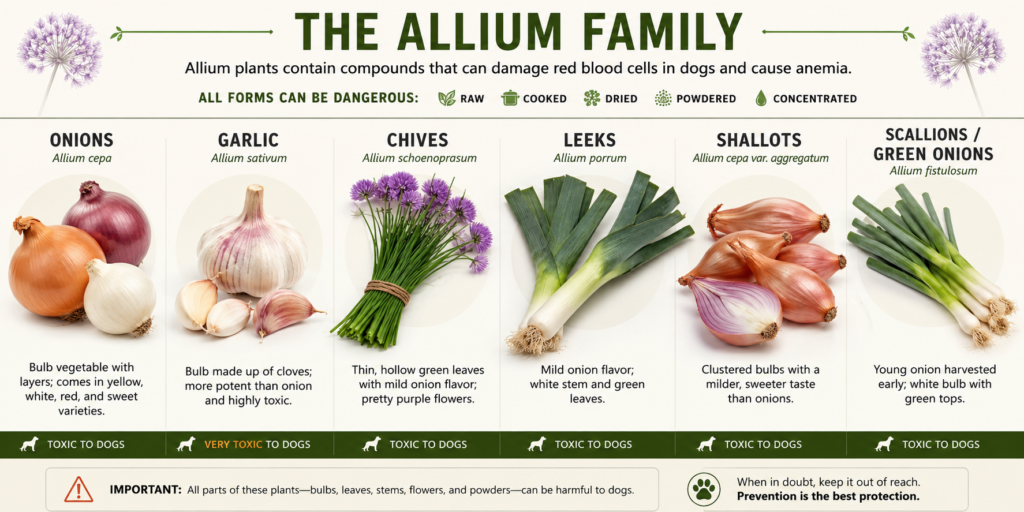
- Onions — Allium cepa
- Garlic — Allium sativum
- Chives — Allium schoenoprasum
- Leeks — Allium porrum
- Shallots
- Scallions and green onions
Garlic is considered more toxic than onion, while concentrated forms such as dried flakes, powders, and seasoning mixes can create a particularly significant exposure because the water has been removed and the compounds are more concentrated. Raw, cooked, dehydrated, powdered, or otherwise processed Allium products can all cause poisoning. (Merck Veterinary Manual)
This means that a dog does not have to dig up an onion from the garden to become poisoned.
A dog might encounter Allium compounds in table scraps, sauces, soups, gravies, seasoning mixes, baby food, dehydrated foods, supplements, or spilled ingredients.
The dangerous part is that a dog may appear completely normal immediately after eating an Allium-containing food. The chemical damage to red blood cells can begin before the owner sees obvious illness, and serious anemia may not become apparent for several days. (Merck Veterinary Manual)
Need Poison Help?
If you know or suspect that your dog has eaten onions, garlic, chives, leeks, shallots, or another Allium-containing product, contact your veterinarian promptly.
You can also contact:
GB-ART-HE0174-image2
ASPCA Animal Poison Control Center:
(888) 426-4435 — available 24/7
Pet Poison Helpline:
(855) 764-7661 — available 24/7
A consultation fee may apply. (ASPCA)

Can Dogs Be Tempted to Eat Onions in the Garden?
Dogs do not necessarily find onions irresistible, but curiosity, smell, boredom, or simply having access to a garden can lead some dogs to chew or dig at Allium plants. This is especially important with dogs that like to investigate new smells or dig in garden beds. The safest approach is to keep dogs physically separated from Allium patches rather than relying on them to avoid the plants. Low garden fencing, raised beds, secure garden borders, or a designated dog-free growing area can all work. Remove discarded onion tops, bulbs, leaves, and damaged plants from areas where dogs can reach them, and do not leave harvested onions drying where your dog can investigate them. If your dog is an enthusiastic garden explorer, treat an Allium bed the same way you would any other potentially poisonous part of the garden: make access impossible rather than expecting your dog to make the right decision.
Symptoms
The symptoms of Allium poisoning can be confusing because the first signs may look like an ordinary stomach problem.
Your dog may develop:
- Loss of appetite
- Drooling
- Nausea
- Vomiting
- Diarrhea
- Abdominal discomfort
- Lethargy or depression
These gastrointestinal symptoms can occur relatively soon after ingestion. However, the more serious problem — damage to red blood cells and anemia — may take several days to become obvious. (Merck Veterinary Manual)
As red blood cells are damaged, symptoms can become much more serious. Watch for weakness, unusual tiredness, rapid breathing, increased heart rate, exercise intolerance, pale gums, yellowing of the gums or eyes, dark or red-brown urine, collapse, or difficulty breathing.
In severe cases, Allium poisoning can result in kidney damage, collapse, and death. (Merck Veterinary Manual)
Watch the Poop — and the Whole Dog
This is where the D.A.W.G. — Dog Poop & Health Index becomes useful.
Diarrhea can be one of the early signs of gastrointestinal irritation after an Allium exposure. But the stool is only one part of the picture.
If your dog’s stool suddenly changes after you suspect it has eaten something it should not have, record the change and pay attention to what happens next.
Stool → Appetite → Energy → Drinking → Urination → Gum color → Breathing
A change in stool followed by weakness, pale gums, dark urine, rapid breathing, or unusual tiredness is much more concerning than a simple episode of loose stool.
The D.A.W.G. system is designed to help owners recognize these changes instead of simply saying, “He has diarrhea.”
Remember that normal-looking stool does not prove that your dog is safe after an Allium exposure. The most dangerous effects may occur later and involve the blood rather than the digestive tract.
Need Poison Help?
If your dog has symptoms following a suspected Allium exposure, contact your veterinarian immediately.
You can also contact:
ASPCA Animal Poison Control Center:
(888) 426-4435 — 24/7
Pet Poison Helpline:
(855) 764-7661 — 24/7 (ASPCA)
Put these numbers in your phone before an emergency happens.
Prevention: When in Doubt, Don’t Share It
If you do not know what is in the food, do not give it to the dog.
The easiest way to treat onion poisoning is to prevent the exposure in the first place.
That sounds obvious until you start looking at the foods people actually eat.
Onions and garlic are not unusual ingredients that appear only in a few recipes. They are used around the world to build flavor. They turn up in soups, sauces, gravies, meat dishes, breads, snacks, seasoning blends, prepared meals, restaurant food, garden vegetables, and hundreds of recipes that do not look anything like an onion or a clove of garlic.
And that is where the hidden danger begins.
A dog does not need to eat a whole onion from the kitchen counter to be exposed to Allium. Onion powder, garlic powder, dried onion, dehydrated garlic, seasoning mixes, and concentrated ingredients can contain much more Allium material by weight than the fresh vegetable. Veterinary references specifically identify dehydrated and powdered forms as important sources of poisoning.
So before giving your dog a bite from your plate, ask yourself a simple question:
“What was used to make this taste good?”
The Hidden Allium Food List
The following foods and dishes may contain onion, garlic, chives, leeks, shallots, scallions, or their dried and powdered forms. Recipes differ, so always check the ingredient label or ask the person who prepared the food.
This is not a list of foods that are automatically dangerous every time you see them. It is a list of foods that deserve a second look before they become a dog treat.
Soups, Stews and Broths
This is one of the biggest areas to watch because onions, garlic, leeks, and powdered seasonings are frequently used as the flavor base.
- French onion soup
- Onion soup
- Vegetable soup
- Chicken soup
- Chicken noodle soup
- Beef soup
- Beef and barley soup
- Tomato soup
- Cream of tomato soup
- Cream of mushroom soup
- Mushroom soup
- Potato soup
- Leek and potato soup
- Lentil soup
- Split-pea soup
- Bean soup
- Black bean soup
- White bean soup
- Minestrone
- Italian wedding soup
- Chicken and rice soup
- Chicken tortilla soup
- Chicken vegetable soup
- Beef vegetable soup
- Mulligatawny soup
- Gumbo
- Seafood chowder
- Clam chowder
- Corn chowder
- Fish soup
- French vegetable soups
- Vegetable stock
- Chicken stock
- Beef stock
- Bone broth
- Bouillon
- Stock cubes
- Stock powder
- Instant soup mixes
- Cup-a-soup style mixes
- Dried soup packets
- Gravy packets
- Soup bases
- Concentrated broth
- Restaurant soups
The powdered and concentrated versions deserve particular attention.
Sauces, Gravies and Condiments
A sauce can hide Allium particularly well because you may never see the original onion or garlic.
- Pasta sauce
- Spaghetti sauce
- Tomato sauce
- Marinara sauce
- Pizza sauce
- Arrabbiata sauce
- Bolognese sauce
- Meat sauce
- Alfredo sauce
- Cream sauces
- Mushroom sauce
- Cheese sauce
- Nacho cheese sauce
- Taco sauce
- Enchilada sauce
- Curry sauces
- Tikka masala sauce
- Korma sauce
- Butter chicken sauce
- Vindaloo sauce
- Thai curry sauces
- Teriyaki sauce
- Stir-fry sauce
- Sweet-and-sour sauce
- Hoisin sauce
- Barbecue sauce
- Burger sauce
- Steak sauce
- Gravy
- Beef gravy
- Chicken gravy
- Sausage gravy
- Mushroom gravy
- Onion gravy
- Brown gravy
- Sunday roast gravy
- Pan gravy
- Meat juices prepared with seasoning
- Marinades
- Meat marinades
- Chicken marinades
- Kebab marinades
- Dipping sauces
- Seafood sauces
- Cocktail sauces
- Relishes
- Chutneys
- Some salsas
- Some tomato relishes
- Some pickled vegetables
Pasta, Rice and Grain Dishes
The pasta or rice itself is usually not the problem. It is what gets added to it.
- Spaghetti Bolognese
- Lasagna
- Cannelloni
- Stuffed pasta
- Ravioli
- Tortellini
- Pasta salads
- Macaroni dishes
- Pasta bakes
- Pasta casseroles
- Carbonara variations
- Pasta primavera
- Pesto pasta
- Garlic pasta
- Creamy garlic pasta
- Risotto
- Mushroom risotto
- Vegetable risotto
- Chicken risotto
- Paella
- Jambalaya
- Dirty rice
- Fried rice
- Chicken fried rice
- Vegetable fried rice
- Egg fried rice
- Pilaf
- Rice casseroles
- Rice bowls
- Burrito bowls
- Seasoned rice
- Mexican rice
- Spanish-style rice
- Garlic rice
- Herbed rice
- Couscous dishes
- Bulgur dishes
- Quinoa bowls
- Grain salads
Pizza and Flatbreads
Pizza is worth its own warning because dogs frequently receive crusts or leftovers.
- Pizza
- Pepperoni pizza
- Meat pizza
- Sausage pizza
- Chicken pizza
- Vegetable pizza
- Garlic chicken pizza
- Garlic pizza
- Calzone
- Stromboli
- Garlic knots
- Garlic bread
- Garlic flatbread
- Focaccia
- Stuffed bread
- Cheese bread
- Pizza dipping sauces
- Pizza seasoning
- Pizza crust seasoning
Even when you cannot see onion or garlic on the pizza, the sauce, meat, seasoning, or crust may contain it.
Meat, Burgers and Sausages
Prepared meat products are another place where Allium can disappear into the recipe.
- Meatballs
- Swedish meatballs
- Italian meatballs
- Beef meatballs
- Turkey meatballs
- Chicken meatballs
- Meatloaf
- Hamburgers
- Homemade burgers
- Restaurant burgers
- Sausages
- Breakfast sausages
- Italian sausage
- Bratwurst
- Chorizo
- Bangers
- Cumberland sausage
- Lincolnshire sausage
- Black pudding
- Meat pies
- Steak pies
- Chicken pies
- Shepherd’s pie
- Cottage pie
- Corned beef
- Beef stew
- Pot roast
- Roast beef seasoning
- Roast chicken seasoning
- Rotisserie chicken
- Prepared chicken
- Chicken wings
- Buffalo wings
- Chicken nuggets
- Chicken tenders
- Chicken strips
- Chicken kebabs
- Beef kebabs
- Lamb kebabs
- Kofta
- Meat skewers
- Meat patties
- Sausage rolls
- Stuffed meats
- Meatloaf mixes
- Burger seasoning
- Steak rubs
- Meat rubs
Never assume that plain-looking meat is actually plain. Prepared meat is often seasoned before it reaches your plate.
Mexican, Tex-Mex and Latin American Foods
Onion and garlic are common ingredients in many dishes in this category.
- Tacos
- Beef tacos
- Chicken tacos
- Fish tacos
- Burritos
- Chimichangas
- Enchiladas
- Fajitas
- Quesadillas
- Nachos
- Nacho cheese
- Salsa
- Pico de gallo
- Guacamole
- Refried beans
- Black beans
- Mexican rice
- Chili con carne
- Chili
- Tamales
- Empanadas
- Tortilla soup
- Carnitas
- Carne asada
- Barbacoa
- Taco meat
- Taco seasoning
- Fajita seasoning
- Enchilada seasoning
- Mexican seasoning mixes
A dog stealing a tortilla is one thing. A dog eating a tortilla covered in seasoned meat, salsa, cheese sauce, or refried beans is a very different situation.
Indian, Middle Eastern and South Asian Foods
Allium ingredients are common in many savory dishes from these cuisines.
- Curry
- Chicken curry
- Lamb curry
- Beef curry
- Vegetable curry
- Chickpea curry
- Dal
- Lentil dal
- Tikka masala
- Butter chicken
- Korma
- Vindaloo
- Rogan josh
- Saag
- Palak dishes
- Biryani
- Pilau
- Samosas
- Pakoras
- Bhaji
- Onion bhaji
- Kofta
- Kebab
- Seekh kebab
- Shawarma
- Doner kebab
- Gyros
- Hummus
- Baba ganoush
- Falafel
- Tahini sauces
- Garlic sauces
- Garlic naan
- Naan
- Paratha
- Chapati dishes
- Chutneys
- Curry pastes
- Curry powders
- Spice pastes
- Marinades
Asian Foods
Many Asian dishes use garlic, scallions, onions, shallots, or combinations of them.
- Stir-fry
- Fried rice
- Chow mein
- Lo mein
- Noodles
- Ramen
- Instant ramen
- Pho
- Pad Thai
- Pad see ew
- Thai curries
- Thai soups
- Satay
- Dumplings
- Gyoza
- Wontons
- Spring rolls
- Egg rolls
- Bao
- Korean barbecue
- Bulgogi
- Japchae
- Kimchi
- Korean stews
- Japanese curry
- Teriyaki dishes
- Yakisoba
- Udon dishes
- Soba dishes
- Chinese dumplings
- Chinese noodle dishes
- Sichuan dishes
- Hotpot broths
- Dim sum
- Scallion pancakes
- Garlic noodles
- Garlic shrimp
- Garlic chicken
- Garlic beef
- Garlic vegetables
Dips, Spreads and Party Foods
These are easy to overlook because they are often served as small amounts alongside other foods.
- Hummus
- Garlic hummus
- Baba ganoush
- Guacamole
- Salsa
- Onion dip
- French onion dip
- Ranch dip
- Garlic dip
- Garlic sauce
- Aioli
- Garlic aioli
- Tzatziki
- Herb dips
- Cheese dips
- Nacho dip
- Seven-layer dip
- Bean dip
- Spinach dip
- Artichoke dip
- Crab dip
- Seafood dip
- Flavored cream cheese
- Garlic cream cheese
- Herb cream cheese
- Onion cream cheese
- Savory spreads
- Sandwich spreads
Breads and Bakery Foods
The bread itself may be harmless while the seasoning or filling is the problem.
- Garlic bread
- Garlic knots
- Garlic rolls
- Garlic baguette
- Garlic naan
- Focaccia
- Onion bread
- Onion rolls
- Savory muffins
- Cheese and onion bread
- Herb bread
- Garlic and herb bread
- Stuffed bread
- Cheese bread
- Savory pastries
- Sausage rolls
- Meat pies
- Stuffed pastries
- Garlic crackers
- Savory crackers
- Seasoned breadsticks
Potatoes and Side Dishes
Potatoes are not the problem. The seasoning often is.
- Garlic mashed potatoes
- Onion mashed potatoes
- Loaded mashed potatoes
- Seasoned roast potatoes
- Garlic roast potatoes
- Garlic fries
- Seasoned fries
- French fries with seasoning
- Potato wedges
- Garlic potato wedges
- Potato skins
- Loaded potato skins
- Hash browns
- Seasoned hash browns
- Potato cakes
- Potato croquettes
- Potato gratin
- Dauphinoise potatoes
- Scalloped potatoes
- Potato salad
- Loaded potato salad
- Garlic potatoes
- Herb potatoes
- Vegetable side dishes
Snacks and Processed Foods
This is where the ingredient label becomes particularly important.
- Potato chips
- Onion-flavored chips
- Sour cream and onion chips
- Garlic chips
- Cheese-flavored chips
- Tortilla chips with seasoning
- Corn chips
- Snack mixes
- Trail mixes with savory seasoning
- Pretzels with seasoning
- Crackers
- Cheese crackers
- Garlic crackers
- Seasoned popcorn
- Flavored popcorn
- Savory biscuits
- Savory snack bars
- Flavored nuts
- Seasoned nuts
- Roasted nuts with savory seasoning
- Flavored rice cakes
- Instant noodles
- Cup noodles
- Ramen seasoning packets
- Microwave meals
- Frozen snacks
- Frozen appetizers
Breakfast Foods
Allium can show up in savory breakfast foods more easily than people expect.
- Breakfast sausage
- Sausage patties
- Sausage links
- Breakfast burritos
- Breakfast sandwiches
- Breakfast wraps
- Omelets
- Vegetable omelets
- Western omelets
- Scrambled eggs with vegetables
- Frittatas
- Quiche
- Savory pancakes
- Hash browns
- Breakfast potatoes
- Breakfast casseroles
- Sausage casseroles
- Egg casseroles
- Savory crepes
Restaurant and Takeaway Foods
Restaurant food deserves extra caution because you may not know exactly what went into the recipe.
- Burgers
- Pizza
- Kebab
- Doner
- Gyros
- Curry
- Stir-fry
- Fried rice
- Noodles
- Pasta
- Lasagna
- Tacos
- Burritos
- Enchiladas
- Fajitas
- Nachos
- Sandwiches
- Wraps
- Paninis
- Subs
- Chicken wings
- Fried chicken
- Rotisserie chicken
- Grilled meat
- Steak
- Meatballs
- Sausages
- Soups
- Stews
- Gravies
- Rice dishes
- Vegetable dishes
- Side dishes
- Restaurant sauces
- Dipping sauces
If you did not prepare the food yourself, you may not know whether Allium was used.
Prepared and Convenience Foods
The more processed the food, the more important the ingredient label becomes.
- Frozen dinners
- Frozen casseroles
- Frozen pasta meals
- Frozen pizzas
- Frozen lasagna
- Frozen meatballs
- Canned soups
- Canned stews
- Canned chili
- Canned pasta
- Canned sauces
- Jarred pasta sauce
- Jarred curry sauce
- Jarred gravy
- Instant mashed potatoes
- Instant rice dishes
- Instant noodles
- Soup mixes
- Gravy mixes
- Stuffing mixes
- Seasoning packets
- Marinade packets
- Rice mixes
- Pasta mixes
- Casserole mixes
- Boxed meal kits
- Prepared sandwiches
- Prepared salads
- Deli foods
- Ready-made meals
Baby Food and Human Supplements
This category deserves special attention because people sometimes assume that food made for babies must be harmless to dogs.
Some prepared human foods, including baby foods and savory meal products, can contain onion or garlic for flavor.
Human nutritional supplements can also contain Allium ingredients or extracts. Veterinary references specifically identify human nutritional supplements as a possible source of exposure.
Never give a dog a human supplement simply because it is marketed as “natural.”
Seasonings: The Ingredient That Can Hide in Plain Sight
This may be the most important part of the entire list.
A dog does not have to eat a recognizable onion or garlic bulb.
Look for these terms on ingredient labels:
- Onion
- Onion powder
- Dried onion
- Dehydrated onion
- Minced onion
- Granulated onion
- Onion flakes
- Onion salt
- Garlic
- Garlic powder
- Dried garlic
- Dehydrated garlic
- Minced garlic
- Granulated garlic
- Garlic salt
- Garlic extract
- Garlic concentrate
- Chives
- Dried chives
- Leek
- Dried leek
- Shallot
- Dried shallot
- Scallion
- Green onion
- Spring onion
And be especially suspicious of:
- Soup seasoning
- Gravy seasoning
- Taco seasoning
- Fajita seasoning
- Curry seasoning
- Meat seasoning
- Steak seasoning
- Chicken seasoning
- Poultry seasoning
- Vegetable seasoning
- Italian seasoning blends
- Garlic and herb blends
- Onion and herb blends
- Barbecue rubs
- Spice mixes
- Marinade mixes
- Stuffing seasoning
- Bouillon powders
- Stock powders
- Instant soup powders
The word “powder” should make you stop and read the label.
Veterinary references specifically note that dehydrated and powdered Allium products can represent a greater poisoning risk because the plant material is concentrated.
The Garden Is Part of the Food Chain Too
The danger does not stop at the kitchen door.
Dogs may encounter Allium plants in vegetable gardens, raised beds, allotments, community gardens, and ornamental plantings.
Keep dogs away from:
- Onions
- Garlic
- Chives
- Leeks
- Shallots
- Scallions
- Spring onions
- Wild onions
- Wild garlic
- Garlic chives
- Harvested bulbs
- Discarded bulbs
- Onion tops
- Garlic leaves
- Chive clippings
- Leek trimmings
- Garden waste containing Allium plants
- Compost containing Allium scraps
Do not assume that because a plant is growing naturally in the garden it is automatically safe for a dog to investigate. Wild onions and other Allium species can also pose a risk.
The Giant-Breed Problem
This matters particularly with giant dogs.
A large dog may be able to reach kitchen counters that smaller dogs cannot. A giant breed can knock something from a table simply by turning around. Some dogs can open low cupboards, investigate garbage cans, pull food from grocery bags, or reach into sinks.
And then there is the garden.
A Great Dane, Mastiff, Irish Wolfhound, Newfoundland, Saint Bernard, or other giant breed may have a very different idea of what counts as “out of reach” than the person who planted the vegetables.
If your dog can reach it, consider it accessible.
Keep Allium plants and foods behind physical barriers whenever possible. Fence vegetable beds, secure garden gates, use dog-proof food storage, keep garbage inaccessible, and put harvested onions and garlic somewhere your dog cannot investigate them.
The Label Test
Before sharing human food with your dog, get into the habit of checking the ingredient list.
You are not looking only for the word “onion.”
You are looking for the entire family:
Onion → Garlic → Chive → Leek → Shallot → Scallion
And you are looking for their concentrated forms:
Powder → Dried → Dehydrated → Granulated → Minced → Flakes → Extract → Concentrate
That thirty-second check could prevent a poisoning emergency.
When in Doubt, Don’t Share It
You do not have to memorize this entire list.
You just need to remember one rule:
If you do not know what is in the food, do not give it to the dog.
A small piece of plain, appropriate food is one thing. A bite of a heavily seasoned human meal is another.
The problem with Allium poisoning is that the dog may look perfectly normal after eating it. The damage to red blood cells can develop over the following days, so waiting for obvious symptoms before taking a known exposure seriously is not a good strategy.
Prevention is much easier than treating hemolytic anemia.
Keep the plants behind a barrier.
Keep the food off the floor.
Keep the garbage secured.
Read the label.
And if your dog does get into something containing onion, garlic, chives, leeks, shallots, or scallions, call your veterinarian or animal poison-control service rather than waiting to see what happens.
Do not assume that cooking makes an Allium plant safe. Raw, cooked, dried, powdered, and concentrated forms can all be dangerous. (Merck Veterinary Manual)
Nutritional Considerations
Nutrition plays a supporting role in nearly every health condition — whether through metabolic balance, inflammation control, structural support, or digestive stability.
While diet alone does not cure this condition, improper feeding can increase physiological stress and worsen outcomes. Calorie excess, nutrient imbalance, and poor digestibility can all add additional strain to the body’s systems.
Proper nutritional alignment should consider:
- Life stage (Puppy, Adult, Senior)
- Activity level (Companion, Active, Working)
- Body condition and weight stability
- Digestive efficiency and stool consistency
- Ingredient quality and nutrient density
For a structured framework on adjusting feeding based on age, metabolism, and activity demand, refer to our Nutrition System Guide.
[Internal Link: Nutrition System Guide]
After an Allium exposure, however, nutrition should never be used as a substitute for veterinary care. If your dog is vomiting, refusing food, developing diarrhea, becoming weak, or showing signs of anemia, the priority is determining whether poisoning has occurred and whether veterinary treatment is necessary.
Monitoring digestion and body condition alongside veterinary care ensures that nutrition supports — rather than complicates — recovery and long-term stability.

Products to Help
The most useful products for preventing Allium poisoning are not medications. They are the things that make accidental access more difficult.
Consider secure food-storage containers for onions, garlic, and powdered seasonings. A dog-proof kitchen trash container can prevent access to discarded food and onion skins. Garden fencing can also help keep curious dogs away from vegetable beds.
For giant breeds, think vertically as well as horizontally.
If your dog can reach the kitchen counter with its nose, then the counter is not really a safe storage location.
Keep potentially dangerous foods, seasonings, supplements, and medications somewhere your dog cannot reach them.
Action — Call the Vet
If you know or suspect that your dog has eaten an onion, garlic, chive, leek, shallot, scallion, or concentrated Allium product, call your veterinarian or an animal poison-control service rather than waiting for symptoms.
Have as much information as possible ready:
What was eaten?
How much was eaten?
When did it happen?
Was it raw, cooked, dried, powdered, or part of another food?
What is your dog’s approximate weight?
Is your dog showing any symptoms?
Do not try to make your dog vomit unless a veterinarian or veterinary poison-control professional specifically tells you to do so. Pet Poison Helpline specifically advises owners not to induce vomiting or give home antidotes without professional guidance.
How to induce vomiting in your dog | Dr Justine Lee
ASPCA Animal Poison Control: (888) 426-4435
Pet Poison Helpline: (855) 764-7661
Both services are available 24/7. (ASPCA)( https://www.aspca.org/pet-care/aspca-poison-control?lang=en&utm_source=chatgpt.com)
Save these numbers in your phone contacts today.
In a poisoning emergency, spending ten minutes searching the internet for the correct number is ten minutes you could have spent getting professional advice.
If Your Dog Ate Something Poisonous, Should You Make It Vomit?
This is one of those situations where the internet can get you into trouble very quickly.
If your dog has eaten something potentially poisonous, your first thought may be:
“I’ve got to get it back out.”
That instinct is understandable. Sometimes making a dog vomit is part of the correct treatment. But sometimes making the dog vomit can cause even more damage.
The first thing to do is call your veterinarian, an emergency veterinary hospital, or an animal poison-control service.
Tell them what your dog ate, approximately how much was eaten, when it happened, your dog’s weight, and whether your dog is showing any symptoms. They can determine whether vomiting is appropriate and, if it is, tell you exactly what to do.
No, Don’t Stick Your Hand Down the Dog’s Throat
Let’s get this one out of the way first.
Do not put your fingers or your entire hand down your dog’s throat to make it vomit.
It is not a reliable method, and it can result in a bite or injury. Dogs do not have the same easy-to-trigger gag reflex that humans do. Pet Poison Helpline specifically warns against this method.
And please forget the other old internet tricks, too.
Do not use salt.
Do not use mustard.
Do not use cooking oil.
Do not use syrup of ipecac.
These methods can cause additional poisoning, aspiration, or other injuries and are not recommended.
So How Do You Make a Dog Vomit?
For dogs, 3% hydrogen peroxide is the only at-home emetic commonly recommended by veterinary poison-control sources, and even that should only be used when a veterinarian or poison-control professional tells you to use it.
That distinction is extremely important.
The question is not:
“How much peroxide does a giant dog need?”
The first question is:
“Should this dog vomit at all?”
A veterinary professional will consider the substance swallowed, the amount, how long ago it was swallowed, the dog’s condition, and the dog’s medical history before deciding.
For example, inducing vomiting can be dangerous if the dog swallowed a corrosive substance, petroleum or hydrocarbon product, sharp object, or certain other materials because bringing the substance back through the esophagus can cause additional injury. Vomiting is also inappropriate when a dog cannot properly protect its airway, is unconscious, is having seizures, is already showing certain serious symptoms, or has other conditions that increase the risk of aspiration.
What About a Giant-Breed Dog?
This is where owners of Great Danes, Mastiffs, Saint Bernards, Newfoundlands, Irish Wolfhounds, and other giant breeds need to be especially careful.
Do not assume that a giant dog simply needs a giant amount of hydrogen peroxide.
Veterinary references describe hydrogen peroxide dosing by body weight and include a maximum amount. That means the calculation does not simply continue upward forever as the dog’s weight increases.
This is one of those moments when having the veterinarian or poison-control professional calculate the amount for you is much safer than trying to remember a number from an article or video.
And if your dog weighs 150 pounds, 180 pounds, or more, tell the poison-control professional the actual weight.
Don’t round it up.
Don’t guess.
Don’t give “about half a cup because he’s enormous.”
Get the professional instruction first.
If the Veterinarian Tells You to Use Hydrogen Peroxide
If a veterinarian or veterinary poison-control professional determines that vomiting should be attempted at home, they may instruct you to use fresh, unexpired 3% hydrogen peroxide and will tell you the appropriate amount and method for your dog.
Have the bottle available when you call.
Check the label.
You want ordinary 3% hydrogen peroxide, not a stronger peroxide product. Stronger concentrations can be dangerous.
A dosing syringe or similar oral dosing device can be useful if a veterinary professional directs you to administer the peroxide. Pet Poison Helpline recommends keeping appropriate dosing equipment in a pet emergency kit.
Once again, though:
The professional decides whether to use it.
The professional determines the amount.
The professional tells you how to administer it.
When You Should NOT Try to Make Your Dog Vomit
Do not attempt to induce vomiting on your own if your dog is:
- Unconscious or extremely drowsy
- Having seizures
- Having serious breathing problems
- Already vomiting repeatedly
- Unable to swallow normally
- Showing significant neurological symptoms
- At high risk of aspiration
You should also never attempt to induce vomiting without professional guidance when the dog has swallowed a corrosive substance, petroleum product, hydrocarbon, or potentially sharp or damaging object.
And if the dog has already developed serious symptoms, this is no longer a “make him throw up at home” situation.
It is a get to the veterinarian situation.
Why Time Matters
With poisoning, time can matter.
Some substances are absorbed quickly. Others remain in the stomach longer. The usefulness of inducing vomiting also depends on what was swallowed and how much time has passed. Veterinary poison-control professionals will use the specific exposure to determine whether vomiting is still appropriate.
That is why you should not spend thirty minutes searching the internet for the perfect home remedy.
Call first.
Then follow the instructions you are given.
Keep This in Your Emergency Kit
If you have dogs, especially giant dogs, it is reasonable to keep some basic emergency supplies available.
A useful emergency kit can include:
Fresh 3% hydrogen peroxide — only for use if directed by a veterinary professional
An oral dosing syringe
Your veterinarian’s phone number
Your nearest emergency veterinary hospital
ASPCA Animal Poison Control: (888) 426-4435
Pet Poison Helpline: (855) 764-7661
Pet Poison Helpline specifically recommends having fresh 3% hydrogen peroxide and appropriate dosing equipment available because there are situations where a veterinary professional may direct an owner to induce vomiting at home.
And One More Thing
Do not wait until your dog has eaten something poisonous to figure out where the peroxide is, what concentration it is, or where the emergency veterinarian is located.
Put the poison-control numbers in your phone.
Know your dog’s approximate weight.
Know the location of the nearest emergency veterinary hospital.
And keep a fresh bottle of 3% hydrogen peroxide where you can find it quickly if a veterinary professional ever tells you that you need it.
Having it available does not mean you should automatically use it.
It means that if a veterinarian says, “Yes, we want you to induce vomiting, and here’s exactly how,” you are prepared to act.
That is the difference between being prepared and experimenting with a poisoned dog.
Why You Should Not Make Your Dog Vomit Unless You Are Told To
When a dog eats something poisonous, your first reaction may be to panic and think, “I have to get it out of him!”
Take a breath.
Stay calm. Call the veterinarian or animal poison-control service. Then follow their instructions.
Making a dog vomit can sometimes be the right treatment, but it is not harmless. The wrong substance, the wrong method, the wrong amount, or simply inducing vomiting when it was not appropriate can create a second emergency on top of the first one.
Possible complications include:
- Aspiration pneumonia — vomited material can enter the lungs instead of leaving through the mouth. This can cause serious lung injury and breathing problems.
- Esophageal injury — some substances can damage the esophagus when swallowed and can cause additional injury when brought back up.
- Stomach irritation or injury — repeated or improperly induced vomiting can severely irritate the stomach.
- Gastrointestinal bleeding — some methods or substances can injure the digestive tract and cause bleeding.
- Worsening of chemical burns — corrosive substances can damage tissues on the way down and again on the way back up.
- Additional poisoning — household “remedies” such as salt or other substances can create another toxic exposure.
- Choking — a dog that cannot properly protect its airway can choke on vomited material.
- Electrolyte disturbances — inappropriate substances or repeated vomiting can disturb the body’s electrolyte balance.
- Severe dehydration — repeated vomiting can cause significant fluid loss.
- Damage to the mouth and throat — inappropriate methods can cause physical injury to the tissues.
- Bite injuries — a frightened, nauseated, or painful dog may bite when someone puts hands or objects into its mouth.
- Delayed treatment — spending time trying home remedies can delay the veterinary treatment the dog actually needs.
Some of these complications can be life-threatening.
This is why veterinary poison-control professionals ask questions before telling you to induce vomiting. What was eaten? How much? When? How large is the dog? Is the dog already showing symptoms? What is the dog’s medical history?
Those questions are not bureaucracy.
They determine whether making the dog vomit is helpful, useless, or dangerous.
If a professional tells you to induce vomiting, follow the instructions they give you. If they tell you not to induce vomiting, do not improvise.
The goal is not simply to make the poison come back up.
The goal is to get the dog safely through the poisoning.
Stay calm. Call first. Then act.
Veterinary Treatment
Treatment depends on what was eaten, how much was consumed, when the exposure occurred, and whether the dog is already showing signs of poisoning.
When an exposure is recent, a veterinarian may consider gastrointestinal decontamination. Depending on the situation, this can include professionally induced vomiting and, in some cases, activated charcoal. These decisions should be made by a veterinarian or veterinary poison-control professional rather than attempted at home. (Merck Veterinary Manual)
Once red blood cell destruction has occurred, treatment becomes primarily supportive.
Veterinary care may include intravenous fluids, oxygen support, monitoring of red blood cell levels, monitoring kidney function, and treatment for anemia. Dogs with severe anemia may require a blood transfusion. (Merck Veterinary Manual)
The important point is that treatment is much more than treating an upset stomach.
The veterinarian is watching for the possibility that Allium compounds have damaged the dog’s red blood cells.
Home Remedies
There is no reliable home remedy that reverses Allium poisoning.
Do not attempt to neutralize the poison with milk, oil, food, salt, or another household substance.
Do not give activated charcoal unless instructed by a veterinarian or veterinary poison-control professional.
Most importantly, do not induce vomiting unless a veterinary professional specifically tells you to do so. Incorrectly induced vomiting can create additional problems, including aspiration into the lungs.
If poisoning is suspected, the correct home action is simple:
Remove the dog from the source, identify what was eaten, collect the packaging if available, and call the veterinarian or poison-control service.
A Giant-Breed Warning
Here is where common sense can get a giant-breed owner into trouble: a bigger dog does not automatically mean a bigger dose. Veterinary guidance for inducing vomiting with 3% hydrogen peroxide uses a weight-based calculation with a maximum of 45 mL. In other words, you should never simply keep increasing the amount because your dog weighs more than an average-sized dog. If a veterinarian or veterinary poison-control professional tells you to induce vomiting, let them determine the appropriate amount for your dog. (Merck Veterinary Manual)
When it comes to a poisoned giant dog, bigger does not mean “give more.” It means “call first.”
Risk Factors
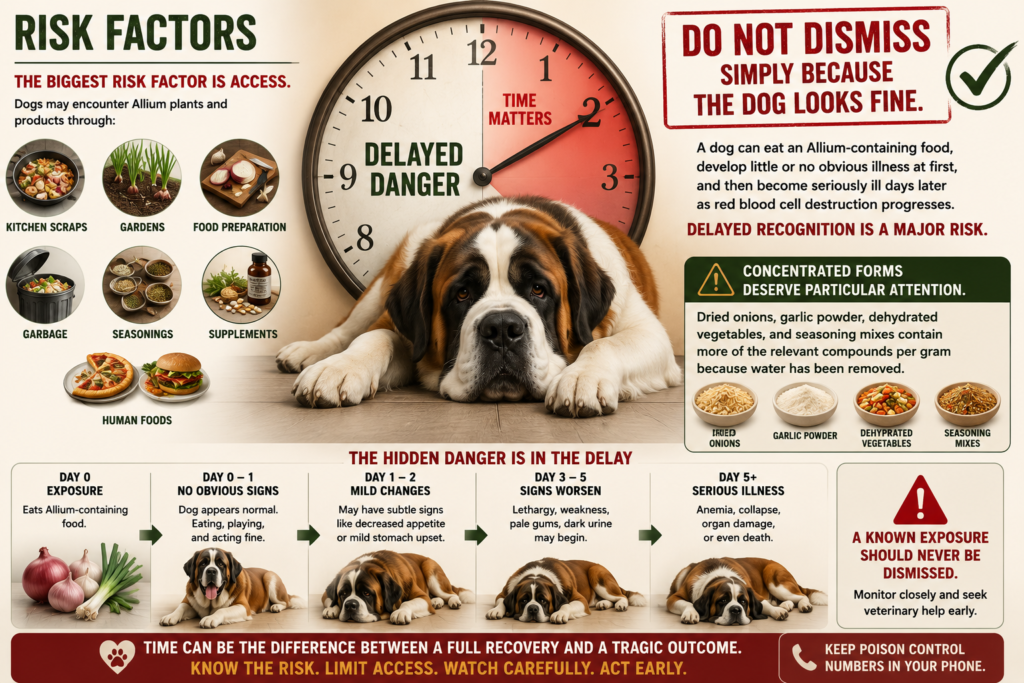
The biggest risk factor is access.
Dogs may encounter Allium plants and products through kitchen scraps, gardens, food preparation, garbage, seasonings, supplements, or human foods.
Concentrated forms deserve particular attention. Dried onions, garlic powder, dehydrated vegetables, and seasoning mixes contain more of the relevant compounds per gram because water has been removed. (Merck Veterinary Manual)
Another risk factor is delayed recognition.
A dog can eat an Allium-containing food, develop little or no obvious illness at first, and then become seriously ill days later as red blood cell destruction progresses.
That is why a known exposure should not be dismissed simply because the dog looks fine.
A list of possible damage that can be caused by inducing vomiting.
Genetic and Breed Considerations
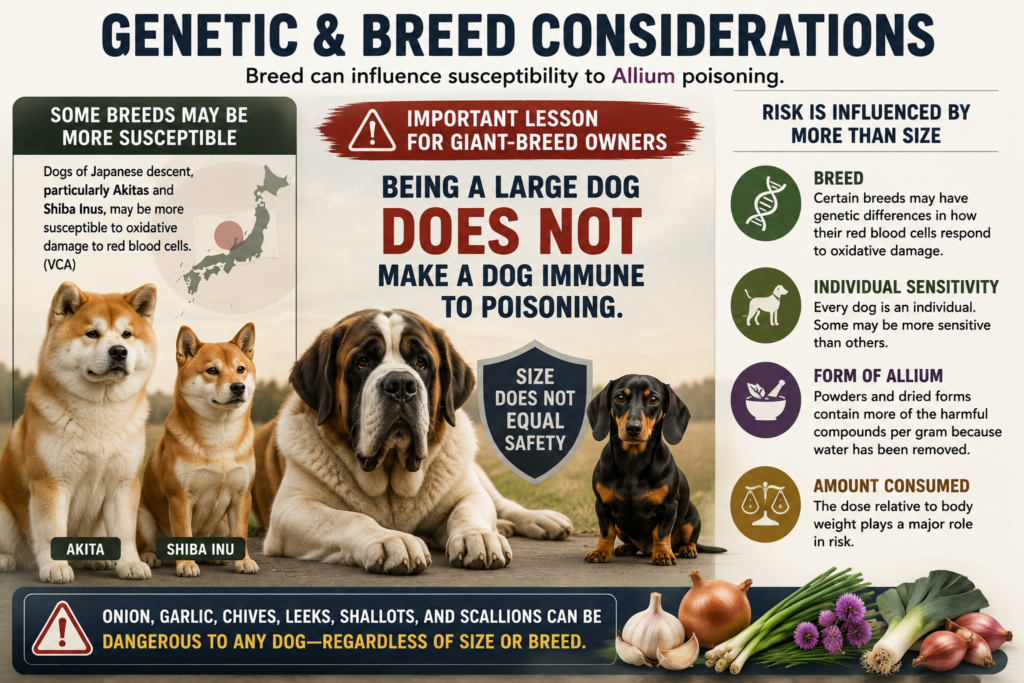
Breed can influence susceptibility to Allium poisoning.
Dogs of Japanese descent, particularly Akitas and Shiba Inus, may be more susceptible to oxidative damage to red blood cells. (Vca)
For giant-breed owners, there is an important lesson here:
Being a large dog does not make a dog immune to poisoning.
Body size can affect the amount of a substance consumed relative to body weight, but it does not make a poisonous plant safe.
Breed, individual sensitivity, the form of the Allium product, and the amount consumed can all influence the risk.
Psychological Factors
There is no psychological disorder that causes Allium poisoning.
However, normal canine behavior can create opportunities for exposure.
Dogs investigate the world with their mouths. They smell, lick, chew, carry, dig, and explore. A dog that is bored, hungry, curious, or simply interested in a new smell may raid the garbage, steal food from a counter, dig through a garden, or chew on something that would never have caught your attention.
This is how a perfectly healthy dog can suddenly become a Trash Dog.
Don’t Let Your Dog Become a Trash Dog
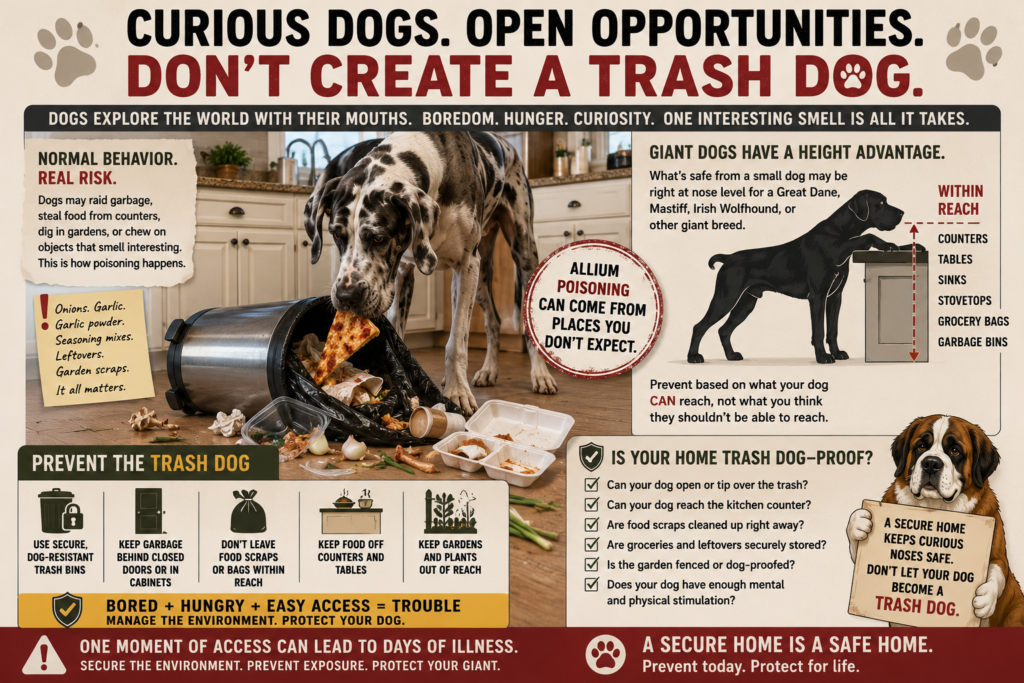
“Trash Dog” is not a breed or a personality type. It is what happens when a dog discovers that the garbage can is an interesting source of smells, food scraps, wrappers, and things worth investigating.
And once a dog discovers the garbage, it may become surprisingly persistent.
That leftover pizza crust may contain garlic. The takeout container may still have onion sauce in it. Yesterday’s soup scraps may contain onion powder. Vegetable trimmings may contain Allium plants. A discarded seasoning packet may still contain enough concentrated ingredients to matter.
The dog does not know any of this.
It just smells interesting.
This is why garbage should be treated as a potential source of poisoning rather than simply a source of mess.
Use a secure, dog-resistant rubbish bin or keep household garbage behind a closed door or inside a cabinet your dog cannot open. Do not leave bags of food waste sitting on the kitchen floor, beside the back door, or where a determined dog can reach them.
And remember that “the dog has never gotten into the garbage before” is not a safety system.
All it takes is one particularly interesting smell.
Giant Dogs Have a Height Advantage
Giant dogs have another advantage when it comes to kitchen exploration:
Height.
A food item that is safely out of reach for a small dog may be directly under the nose of a Great Dane, Mastiff, Irish Wolfhound, Saint Bernard, Newfoundland, or another giant breed.
Counters, tables, sinks, stovetops, grocery bags, and even the tops of some rubbish bins can become accessible simply because the dog is enormous.
This means prevention should be based on what your dog can actually reach, not what you believe it should be able to reach.
If your dog can reach the counter, the counter is not safe storage.
If your dog can open the bin, the bin is not secure.
If your dog can get through the garden fence, the garden is not dog-proof.
If your dog can smell it and reach it, assume that eventually it will investigate it.
Prevent the Trash Dog Before It Starts
The goal is not to teach your dog that garbage is poisonous.
The goal is to make sure the dog never gets the opportunity to find out what is inside it.
Secure the garbage.
Keep food scraps contained.
Clean up dropped food promptly.
Store human food where the dog cannot reach it.
Keep garden waste out of the dog’s area.
And never underestimate a bored or hungry giant dog with an interesting smell within reach.
A secure rubbish bin may not look like a piece of poisoning prevention equipment, but it can be exactly that.
The best Trash Dog is the one that never gets the chance to become one.
Surgical Options
Surgery is not normally the treatment for Allium poisoning itself.
The primary concern is chemical damage to the red blood cells, not a physical blockage caused by the plant.
However, veterinary treatment depends on the individual circumstances. If an unusual complication occurs, the veterinary team will determine whether another procedure is necessary.
Do not assume that because surgery is unlikely, the poisoning is therefore minor.
The serious part of Allium toxicity is the damage that can occur inside the bloodstream.
Monitoring
Monitoring is particularly important because the most serious symptoms may be delayed.
After a known or suspected exposure, follow the monitoring instructions given by your veterinarian or poison-control professional.
At home, watch for changes in:
Appetite → Energy → Stool → Vomiting → Drinking → Urination → Gum color → Breathing → Urine color
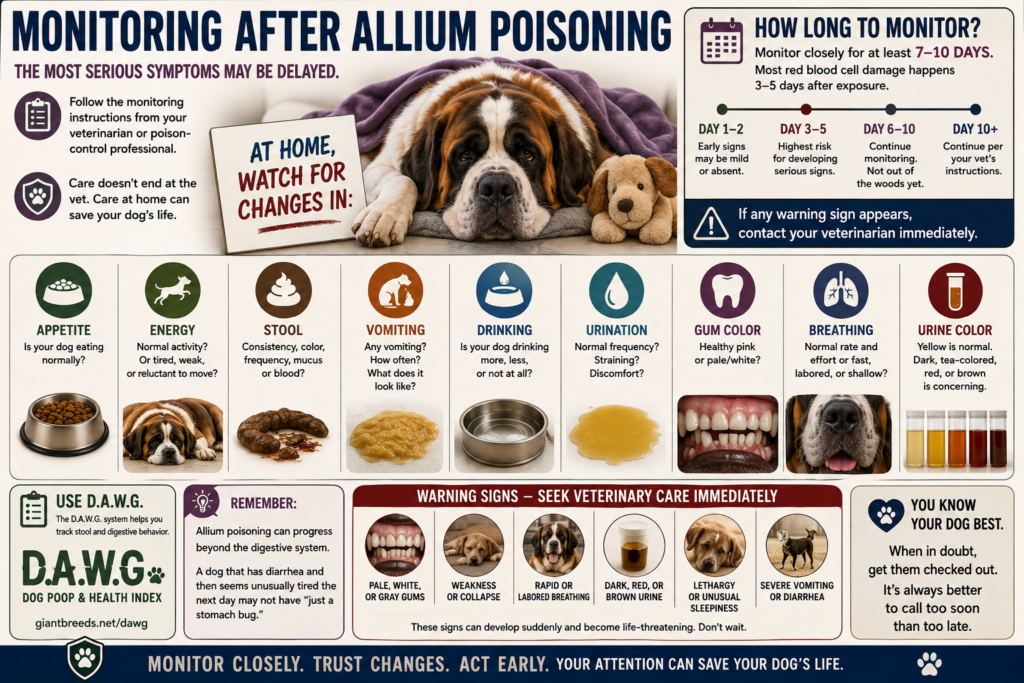
The D.A.W.G. system can help you record changes in stool and digestive behavior, but remember that Allium poisoning can progress beyond the digestive system.
A dog that develops diarrhea and then seems unusually tired the next day should not simply be assumed to have an ordinary stomach bug if an Allium exposure has occurred.
Pale gums, weakness, rapid breathing, collapse, or dark/red-brown urine are particularly concerning signs and warrant immediate veterinary attention. (Merck Veterinary Manual)
Emergency Contacts
Save these numbers in your phone before you need them.
ASPCA Animal Poison Control Center
(888) 426-4435
Available 24 hours a day, 365 days a year. A consultation fee may apply. (ASPCA)
Pet Poison Helpline
(855) 764-7661
Available 24/7. An incident fee applies. (Pet Poison Helpline)
Your Veterinarian
Nearest 24/7 Emergency Veterinary Hospital
Do not wait for an emergency to find these numbers.
Create an emergency contact in your phone for your dog today.
A useful format is:
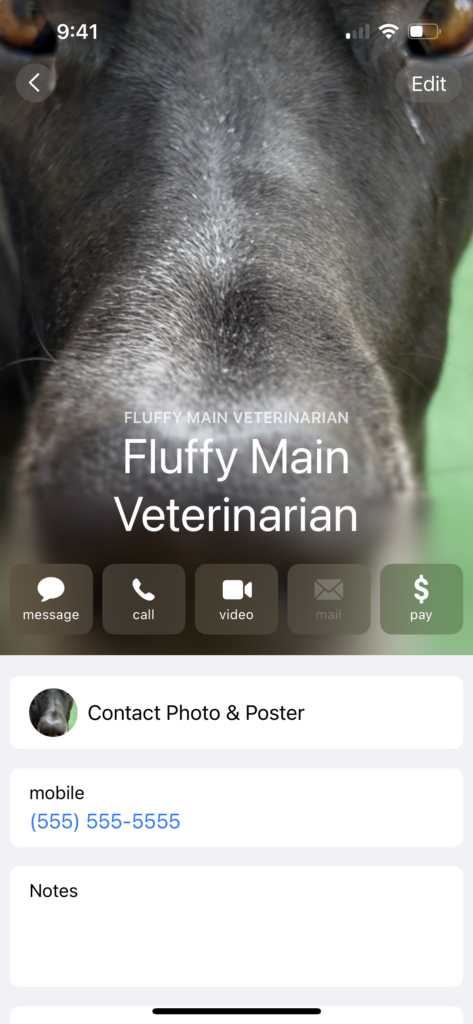
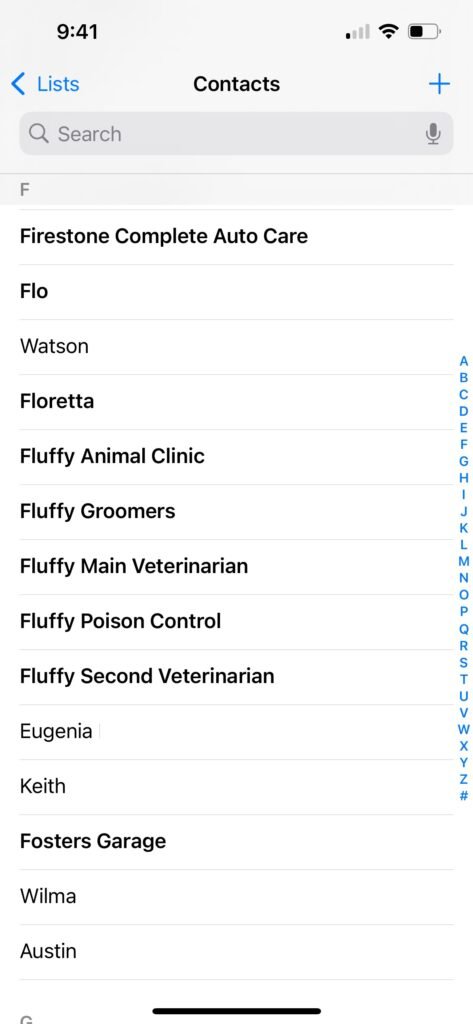
Store your primary veterinarian, nearest emergency hospital, and animal poison-control numbers together under your dog’s name on your phone
The Giants Takeaway
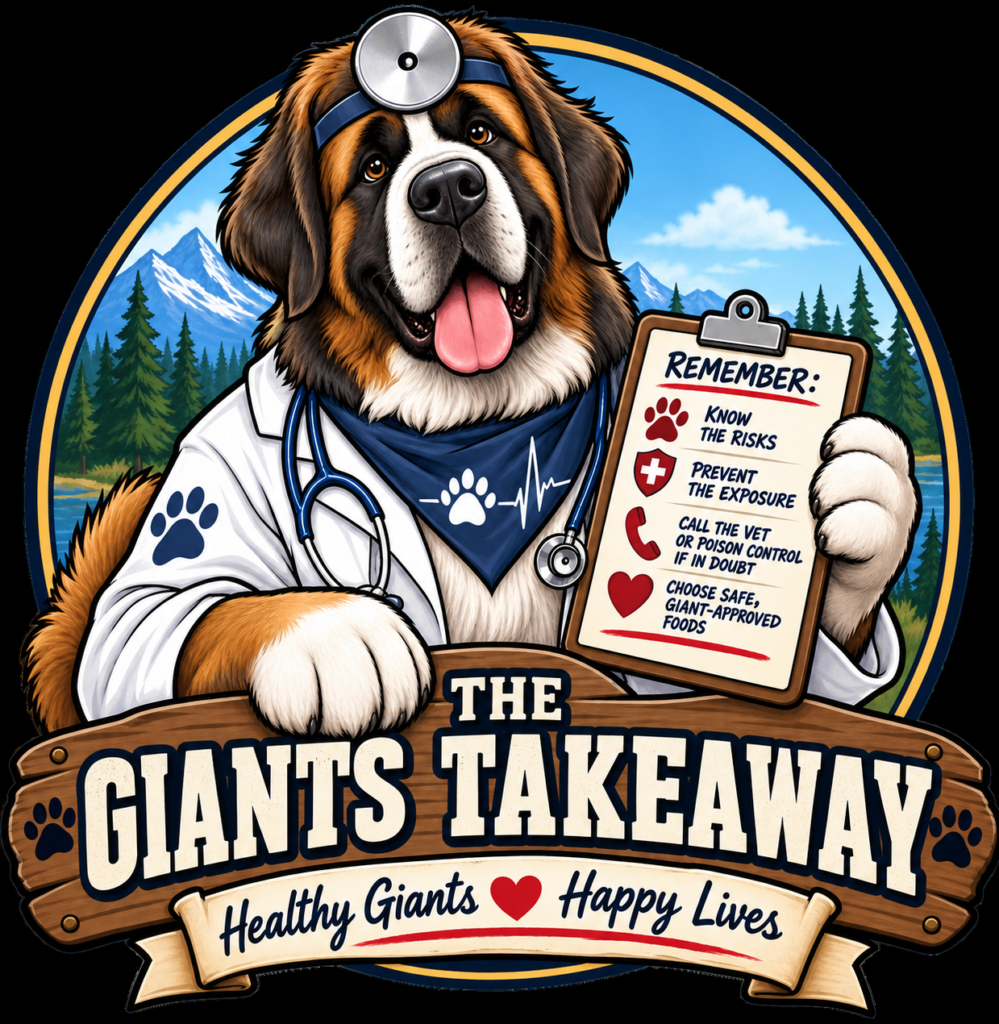
Onions are not just an ingredient to avoid. They are part of a much larger family of plants called Allium, which includes garlic, chives, leeks, shallots, scallions, and related plants.
The important thing to remember is that raw, cooked, dried, powdered, and concentrated forms can all be dangerous to dogs.
And the most important warning is this:
Your dog can look fine before serious poisoning becomes obvious.
If your dog has eaten an Allium plant or food containing onion or garlic, do not wait for vomiting, diarrhea, pale gums, weakness, or dark urine before asking for help.
Call your veterinarian or animal poison-control service.
Then monitor your dog carefully and use the D.A.W.G. system to help record changes in stool and other digestive signs.
Know the signs. Know what your dog can reach. Know the phone numbers.
And put those poison-control numbers in your phone today.
