Raw Diets & Poop Changes
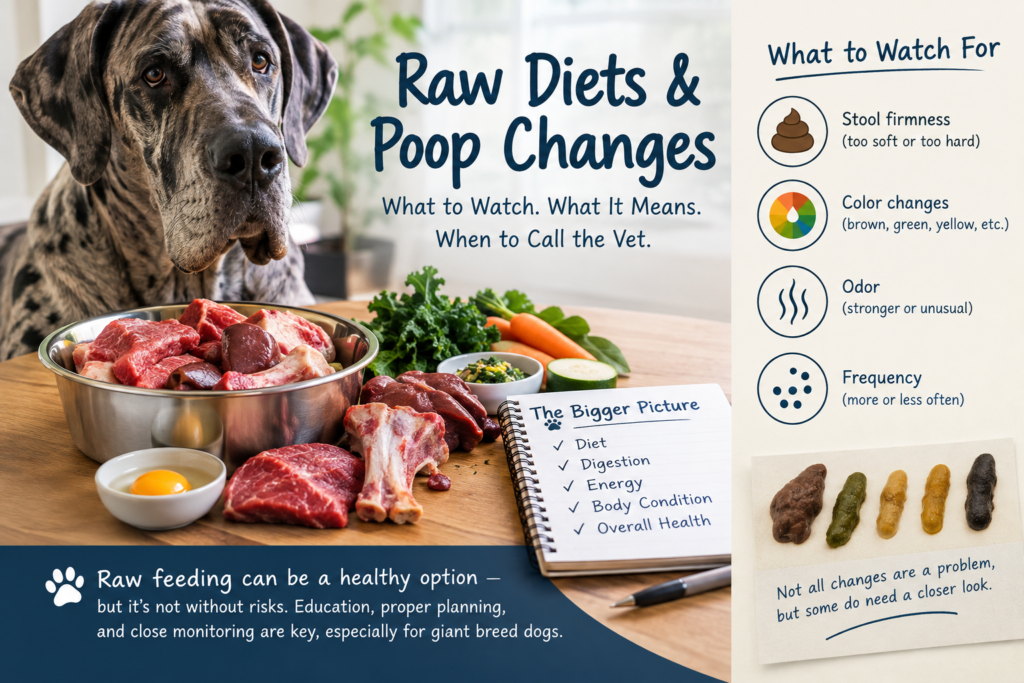
Changing what your giant breed dog eats can change what comes out the other end.
This is especially noticeable when a dog moves from a traditional dry or canned diet to a raw diet. The stool may become smaller, firmer, darker, or less frequent. Sometimes that is simply the result of a different diet being digested.
But poop is also one of the easiest ways to notice that something is not agreeing with your dog.
A sudden change in stool should therefore be treated as information, not automatically as a problem and not automatically as something to ignore.
For giant breed owners, that distinction matters. A very large dog can still become dehydrated quickly from repeated vomiting or diarrhea, while growing giant breed puppies have particularly important nutritional requirements.
Definition
A raw diet is a feeding plan based partly or entirely on uncooked animal ingredients. Depending on the diet, this can include raw meat, organs, bones, eggs, vegetables, supplements, or commercially prepared raw food.
Raw diets vary considerably. A commercially prepared product designed to be complete and balanced is very different from a homemade bowl of meat and bones.
That difference matters because a diet can contain plenty of protein and still fail to provide the correct balance of vitamins, minerals, fatty acids, and other nutrients. Veterinary sources note that homemade raw diets are particularly likely to be incomplete unless they have been properly formulated.
The phrase “raw” does not describe the nutritional quality of a diet. It only describes how the food is prepared.
What Does Raw-Diet Poop Look Like?
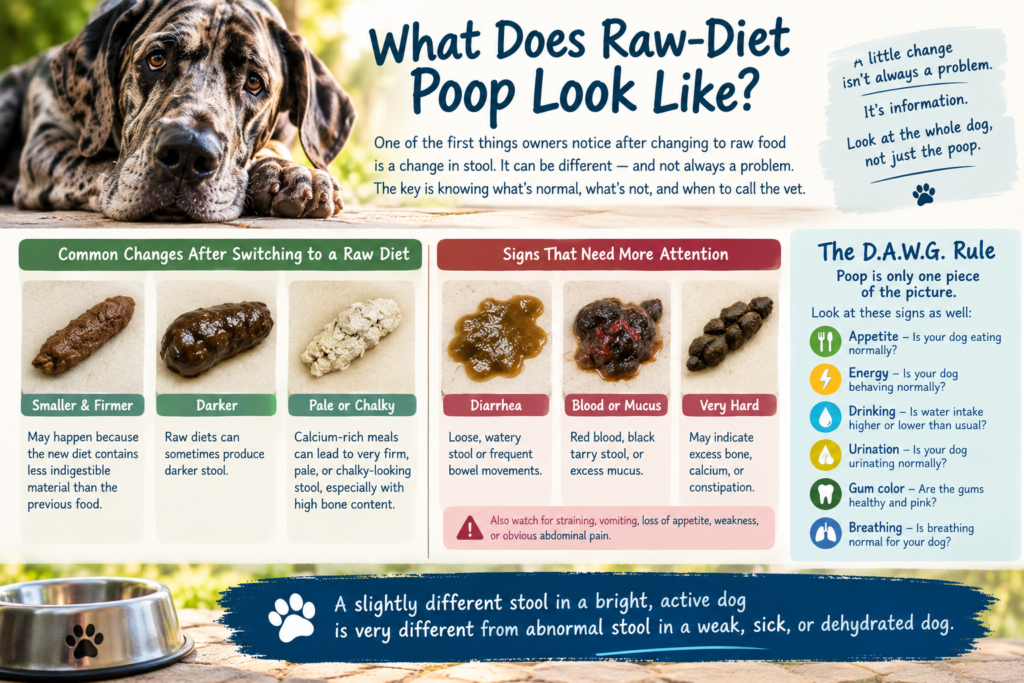
One of the first things owners notice after changing to raw food is a change in stool.
Some dogs produce smaller, firmer stools because the new diet may contain less indigestible material than their previous food. Stool may also become darker.
Calcium-rich meals can produce very firm, pale, or even chalky-looking stool. This can happen when a diet contains a large amount of bone or calcium.
A small change in stool is not necessarily a reason to panic.
The important question is whether the change is stable and appropriate for your individual dog, or whether the stool is telling you that something is wrong.
Repeated diarrhea, very hard stools, blood, large amounts of mucus, black tar-like stool, straining, vomiting, loss of appetite, weakness, or obvious abdominal pain deserve more attention.
And remember the D.A.W.G. rule:
Poop is only one piece of the picture.
Look at Appetite, Energy, Drinking, Urination, Gum color, and Breathing as well. A slightly different stool in an otherwise bright, active dog is a very different situation from abnormal stool accompanied by weakness, vomiting, or dehydration.
Symptoms
Raw-diet-related digestive problems can range from mild changes to serious illness.
The most obvious sign is a change in stool. This may mean diarrhea, constipation, unusually hard stool, mucus, blood, or a major change in frequency or appearance.
Some dogs may also develop vomiting, reduced appetite, abdominal discomfort, excessive thirst, or a noticeable drop in energy.
There is another concern that is easy to overlook.
Raw pet food can carry harmful bacteria such as Salmonella and Listeria monocytogenes. Dogs may become ill, but they can also carry and shed some bacteria without appearing sick. The FDA has repeatedly warned about this risk, including recent recalls involving raw dog foods contaminated with harmful bacteria.
That means unusual poop after eating raw food should not automatically be blamed on “the adjustment period.”
Sometimes the food itself may be contaminated.
Prevention
The safest way to approach a raw diet is to treat it as a complete feeding system rather than simply replacing cooked food with uncooked meat.
If you choose a commercial raw diet, look for a nutritional adequacy statement showing that it is intended to provide complete and balanced nutrition for the appropriate life stage. Not every raw product is designed to be a complete diet.
Homemade raw diets require even more care. Meat, organs, bones, and a few vegetables may look like a complete meal, but appearance does not tell you whether the diet contains the correct amounts and proportions of essential nutrients.
Food safety matters, too.
Raw food should be handled with the same seriousness you would use when handling raw meat for people. Wash hands, clean food-contact surfaces, keep raw food away from human food preparation areas, and clean up stool promptly.
Freezing does not reliably eliminate bacteria such as Salmonella.
Nutritional Considerations
Nutrition plays a supporting role in nearly every health condition — whether through metabolic balance, inflammation control, structural support, or digestive stability.
While diet alone does not cure this problem, improper feeding can increase physiological stress and worsen digestive problems. Calorie excess, nutrient imbalance, excessive bone or calcium, and poor digestibility can all create additional strain.
Proper nutritional alignment should consider:
- Life stage: Puppy, Adult, or Senior
- Activity level: Companion, Active, or Working
- Body condition and weight stability
- Digestive efficiency and stool consistency
- Ingredient quality and nutrient density
Giant breed puppies deserve special attention because growth is not simply a matter of giving them more food. Their developing skeleton requires appropriate energy and nutrient balance.
For a structured framework on adjusting feeding based on age, metabolism, and activity demand, refer to our Nutrition System Guide.
Monitoring digestion and body condition alongside veterinary care helps ensure that nutrition supports — rather than complicates — long-term health.
Products to Help
The most useful products are not necessarily products that “fix” poop.
They are products that help you feed consistently and observe accurately.
A reliable food scale can help maintain consistent portions. Appropriate food-storage containers and dedicated preparation tools can help reduce contamination when handling raw food. A simple notebook or tracking sheet can also be surprisingly useful when changing diets.
Record what your dog ate, how much was fed, and what the stool looked like afterward.
That creates a much clearer picture than trying to remember what happened three days ago.
Action — Call the Vet
Call your veterinarian when stool changes are persistent, severe, or accompanied by other symptoms.
Do not wait several days simply because your dog recently started eating raw food.
Your veterinarian will want to know what your dog has eaten, when the diet changed, how much was fed, and what the stool looks like. If possible, take a photograph of unusual stool. It can be surprisingly useful when describing what you have seen.
If you suspect the food itself may be contaminated, keep the packaging and lot information rather than throwing everything away immediately. That information may help identify a recalled product.
Veterinary Treatment
Treatment depends on what caused the stool change.
A mild dietary reaction may require nothing more than adjusting the feeding plan under veterinary guidance.
More serious diarrhea or vomiting may require fluids, medication, diagnostic testing, or treatment for an infection.
If your veterinarian suspects nutritional imbalance, the feeding plan may need to be completely reassessed.
The important point is that “raw” is not a diagnosis.
Your veterinarian needs to determine whether the problem is dietary intolerance, excessive bone or calcium, infection, parasites, an underlying gastrointestinal condition, or something else entirely.
Home Remedies
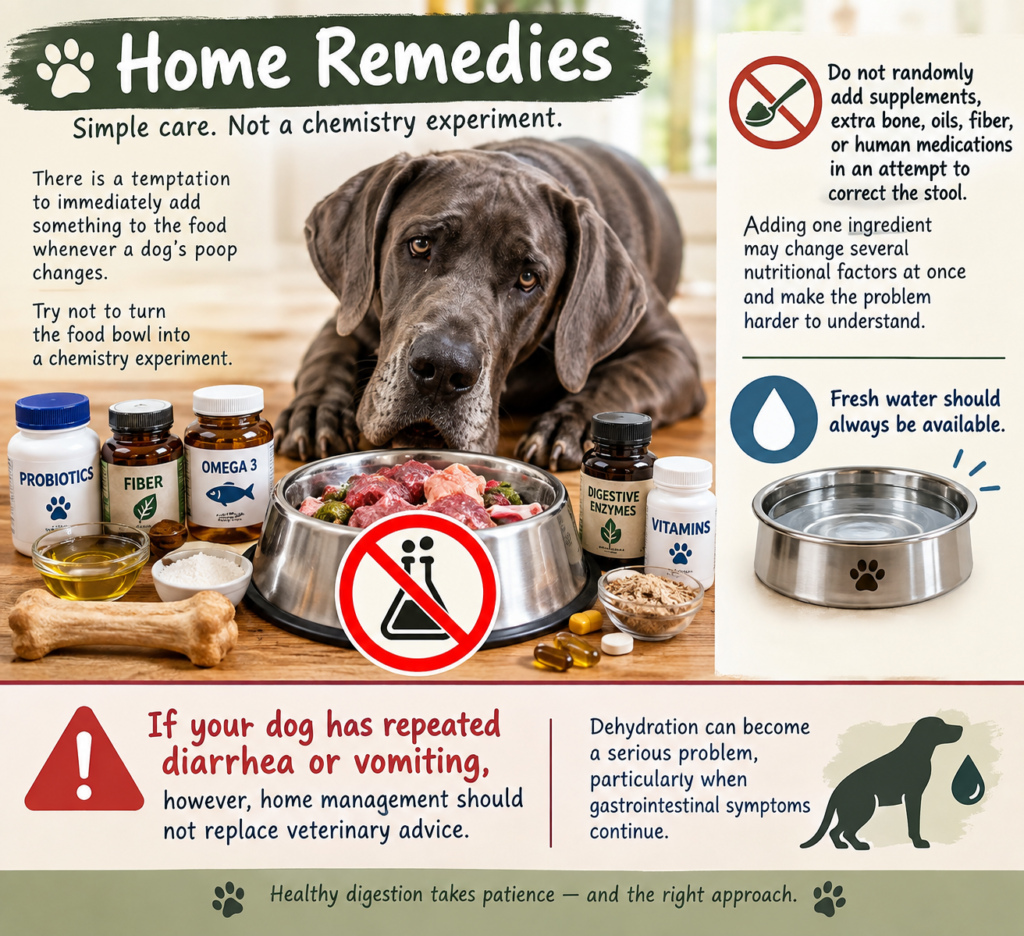
There is a temptation to immediately add something to the food whenever a dog’s poop changes.
Try not to turn the food bowl into a chemistry experiment.
Do not randomly add supplements, extra bone, oils, fiber, or human medications in an attempt to correct the stool. Adding one ingredient may change several nutritional factors at once and make the problem harder to understand.
Fresh water should always be available.
If your dog has repeated diarrhea or vomiting, however, home management should not replace veterinary advice. Dehydration can become a serious problem, particularly when gastrointestinal symptoms continue.
Risk Factors
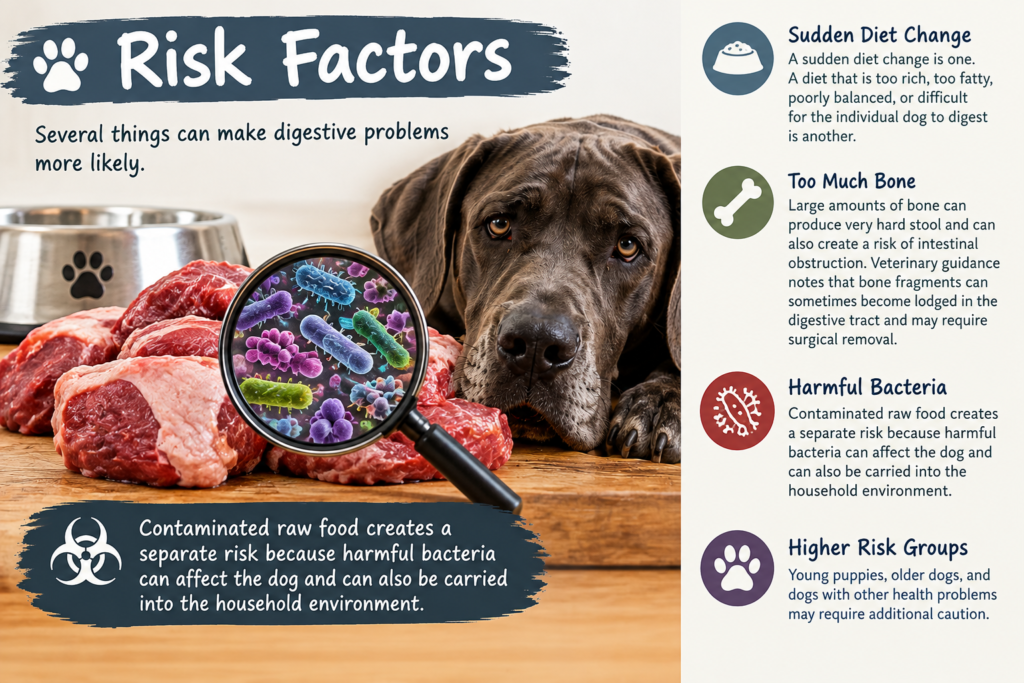
Several things can make digestive problems more likely.
A sudden diet change is one. A diet that is too rich, too fatty, poorly balanced, or difficult for the individual dog to digest is another.
Large amounts of bone can produce very hard stool and can also create a risk of intestinal obstruction. Veterinary guidance notes that bone fragments can sometimes become lodged in the digestive tract and may require surgical removal.
Contaminated raw food creates a separate risk because harmful bacteria can affect the dog and can also be carried into the household environment.
Young puppies, older dogs, and dogs with other health problems may require additional caution.
Genetic and Breed Considerations
There is no single “giant breed raw diet.”
A Great Dane, Mastiff, Newfoundland, Irish Wolfhound, Saint Bernard, and Leonberger may all be giant breeds, but they are still individual dogs with different histories, activity levels, digestive systems, and nutritional needs.
Breed can influence the way a dog grows and the stresses placed on its skeleton, particularly during puppyhood. That makes proper nutritional balance especially important during growth.
Do not assume that because a diet worked beautifully for one giant breed dog it will automatically work for another.
The dog in front of you is the one you need to feed.

🥩 If You Choose to Feed Raw
If you decide that raw feeding is something you want to explore, start with education rather than the freezer aisle.
Raw feeding is not simply a matter of putting raw meat in a bowl. A complete diet has to provide the right balance of energy, protein, fat, vitamins, minerals, and other nutrients. This becomes especially important with giant breed puppies, whose growing bones and joints have very specific nutritional requirements.
Before changing your dog’s food, talk with your veterinarian. If possible, work with a board-certified veterinary nutritionist or another qualified professional who can evaluate the actual diet you plan to feed. The American College of Veterinary Nutrition maintains a directory of veterinary nutrition specialists that can help owners find professional nutritional guidance.
If you are considering a homemade raw diet, ask the person helping you to evaluate the entire recipe, not just individual ingredients. A bowl containing meat, organs, bone, and vegetables may look nutritious while still being deficient or excessive in important nutrients.
Commercial raw foods are another option. Look for products that clearly state whether they are intended to be complete and balanced for your dog’s particular life stage. Do not assume that every product labelled “raw,” “natural,” or “premium” provides everything your dog needs.
Food safety education is just as important as nutritional education. Raw animal foods can carry bacteria that may affect dogs and people. Learn how to store, thaw, prepare, serve, and clean up after raw food before you begin. The FDA, your veterinarian, and veterinary nutrition professionals are useful places to start.
And then there is the most important expert sitting right in front of you:
Your dog.
If your dog consistently refuses the raw diet, don’t force the issue simply because you have decided that raw feeding is the right choice.
Your dog may be telling you:
“This isn’t for me.”
One refused meal can happen for many reasons. A persistent refusal, especially when accompanied by digestive problems or other changes in behavior, deserves attention.
There is no prize for making a particular feeding philosophy work.
The goal of the Giant Breeds Feeding System is not to prove that one type of food is superior to another. The goal is to help an owner provide appropriate nutrition for the individual dog while monitoring body condition, digestion, energy, and overall health.
If raw feeding works for your dog and is properly formulated and safely handled, it can be part of the feeding conversation.
If it doesn’t work for your dog, listen to the dog.
Resources for Getting Started
For owners who want to learn more before making the change, begin with professional sources rather than social-media recipes or anonymous feeding groups.
- Your veterinarian — Start here, particularly if your dog is a puppy, senior, underweight, overweight, or has an existing health concern.
- A veterinary nutritionist — Useful for evaluating homemade diets and nutritional requirements.
- American College of Veterinary Nutrition (ACVN) — A professional resource for finding veterinary nutrition specialists.
- FDA Center for Veterinary Medicine — Information about pet-food safety, recalls, and risks associated with raw pet food.
- Your raw-food manufacturer — If using a commercial product, read the nutritional adequacy statement, feeding directions, storage instructions, and safety information supplied by the manufacturer.
The purpose of this sidebar is not to teach you how to formulate a raw diet.
It is to make sure that if you decide to walk down that road, you know where the road actually begins.
General Info and Tips About Feeding a Raw Food Diet to Cats and Dogs
Biologically Appropriate Raw Diets
VCA Westcreek Animal Hospital
Psychological Factors
Dogs notice changes in their food, routine, and environment.
Some dogs become excited about a new diet. Others may become hesitant, eat too quickly, guard the new food, or simply refuse it.
Stress can also influence digestion.
If a diet change happens at the same time as boarding, travel, a new animal in the home, a major household change, or another stressful event, it may be difficult to know which factor caused the stool change.
This is another reason to change one major thing at a time whenever possible.
If you change the food, change the food.
Don’t change the food, treats, supplements, feeding schedule, and exercise routine all on the same weekend and then try to figure out which one caused the problem.
Surgical Options
Most changes in stool do not require surgery.
There is, however, one raw-diet concern that should always be taken seriously: foreign material or bone becoming lodged in the digestive tract.
An obstruction can prevent food and fluids from moving normally through the intestines. Depending on the location and severity, treatment may involve imaging, endoscopy, or surgery.
Vomiting, repeated attempts to vomit, severe abdominal pain, extreme lethargy, refusal to eat, a swollen abdomen, or inability to pass stool can indicate a serious gastrointestinal problem.
That is not a “wait and see what tomorrow’s poop looks like” situation.
Monitoring
This is where the D.A.W.G. system becomes especially useful.
Don’t monitor the poop by itself.
Watch the whole dog.
Appetite: Is your dog eating normally?
Energy: Is your dog behaving normally?
Drinking: Is water intake noticeably higher or lower?
Urination: Is your dog urinating normally?
Gum color: Are the gums their normal healthy color?
Breathing: Is breathing normal for your dog?
Then look at the stool.
Is it formed or loose? Is your dog straining? Is there mucus or blood? Has the color changed? Is it unusually hard or chalky? Is your dog going much more or less often than usual?
A simple record over several days can reveal patterns that are difficult to see from memory alone.
And if several D.A.W.G. indicators change at the same time, the poop may be only the most visible part of a larger problem.
Emergency Contacts
Keep your regular veterinarian’s number where you can find it quickly.
Also keep the number and address of the nearest emergency veterinary hospital.
If your dog develops severe or repeated vomiting, bloody diarrhea, collapse, extreme weakness, severe abdominal pain, a swollen abdomen, difficulty breathing, or other signs of a potentially life-threatening problem, contact an emergency veterinarian immediately.
When in doubt, call.
You do not have to diagnose the problem before asking for help.

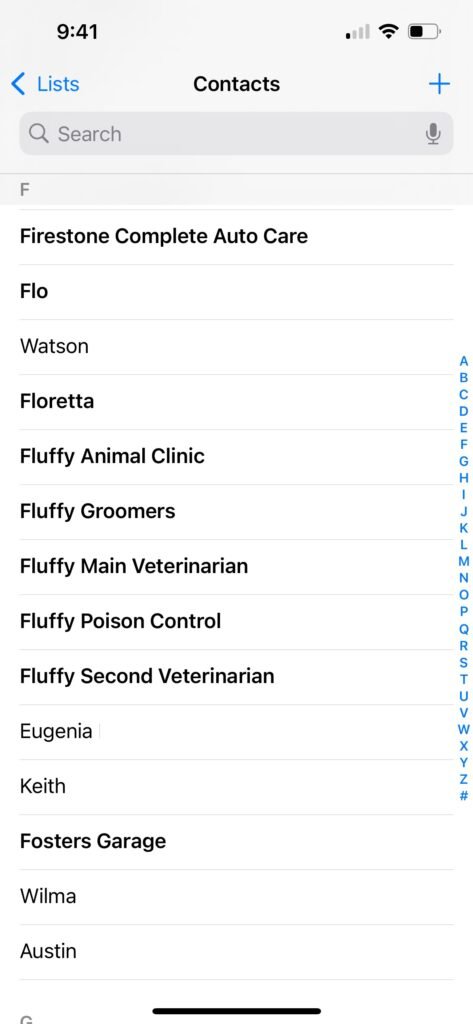
🥩 Raw Diets Are Not All the Same
The term “raw diet” covers several different feeding approaches, and they are not interchangeable. Some owners follow BARF-style diets that combine raw meat, organs, edible bone, and sometimes plant ingredients or supplements. Others follow prey-model or whole-prey approaches that try to more closely reproduce what an animal might eat in nature. There are also commercially prepared raw foods, including products formulated to be complete and balanced, as well as complementary products meant to make up only part of a dog’s diet. Finally, some owners prepare their dog’s entire diet at home using recipes or professional formulations. The important thing to remember is that “raw” describes the way food is fed, not whether the diet is complete, balanced, appropriate for your dog’s life stage, or safely prepared. Before choosing one, understand which feeding system you are actually considering.
| Approach | Basic idea |
| BARF | Raw meat, edible bone, organs, and usually some plant ingredients such as vegetables or fruit; may also use supplements. |
| Prey Model Raw (PMR) | Attempts to approximate a whole prey animal using muscle meat, bone, organs and other animal parts, with little or no plant material. |
| Whole Prey | Feeds an actual whole prey animal or portions intended to reproduce whole-prey nutrition, sometimes including skin, fur or feathers. |
| Commercial Complete Raw | A manufacturer formulates the food to meet stated nutritional requirements; commonly sold fresh, frozen, or freeze-dried. |
| Commercial Complementary Raw | Raw food intended to be only part of the diet or used as a topper/treat rather than the sole food. |
| Home-Prepared Raw | The owner buys the ingredients and prepares the diet themselves, following a recipe or formulation. |
| Premix + Raw Meat | A prepared vitamin/mineral/other nutrient mix is combined with the owner’s chosen raw meat according to the product’s directions. |
The Giants Takeaway
Raw feeding can change a dog’s poop.
That part is real.
But “different” does not automatically mean “healthy,” and it does not automatically mean “dangerous.”
A smaller, firmer stool may simply reflect a different diet. A dog producing very hard, chalky stool after eating large amounts of bone may need its diet reassessed. A dog with diarrhea, vomiting, weakness, fever, blood in the stool, or other changes may have something more serious happening.
The important thing is to look at the entire dog rather than judging the diet by the poop alone.
Feed for the dog’s actual nutritional needs. Change diets carefully. Handle raw food safely. Watch the stool. Watch the dog.
And remember the Giant Breeds rule: